



Hey there,
Back in 2024, I remember seeing an article saying that Klarna said its AI assistant was doing the work of 700 full-time agents. Then, suddenly, the next year it famously made a VERY well-publicised about-turn; its CEO said it was hiring human agents again so customers could always reach a person. By September 2025 he was telling Reuters that Klarna had leaned too hard on cutting costs.
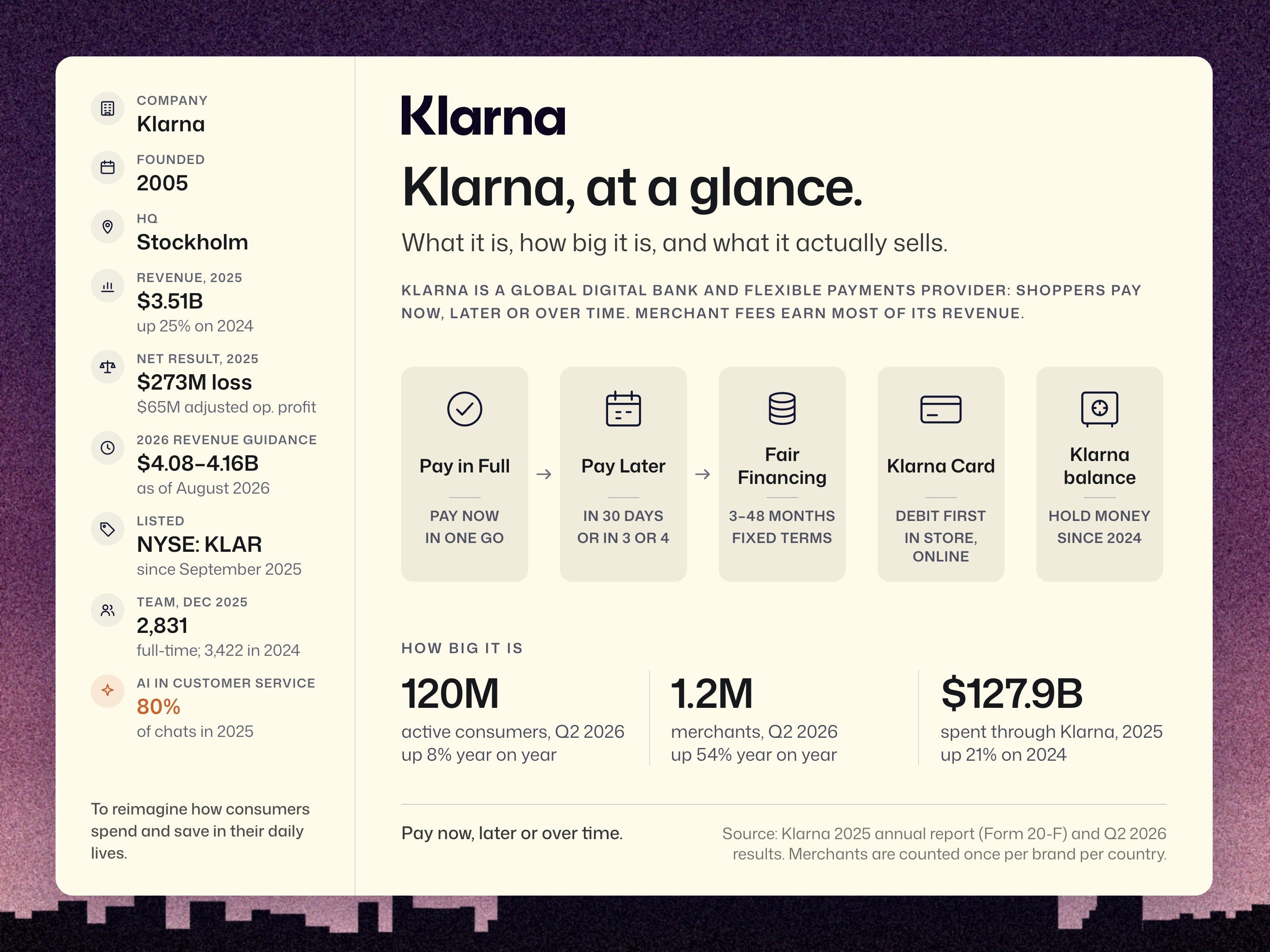
But for those unfamiliar, Klarna is a Swedish payments company that lets shoppers pay now, later or over time. It started in 2005 with three students at the Stockholm School of Economics: Sebastian Siemiatkowski, Niklas Adalberth and Victor Jacobsson, but with more of a whimper than a bang.
The three entered their school’s annual business idea competition with a way to make online shopping easier and safer, by letting people pay after their goods arrived. But I’m afraid the investors judging the final turned it down, and the entry finished near the bottom.
Then in true entrepreneurial spirit they started it anyway. Twenty years later Klarna has about 120 million consumers, listed in New York in September 2025, and Siemiatkowski is still its CEO.
I had initially thought that this would be a strong lesson in how not to run AI inside your company. However, after trawling through their annual reports, and first-hand interviews and articles, I think that mistakes were made but they have also driven substantial value - claiming $59 million in cost savings.
The headlines weren’t kind to Klarna but looking across the whole company I think it’s a four-part lesson in where AI creates value, where cost-cutting breaks customer trust, and how to redesign the human roles around it. Let’s dig in.
TL;DR: Q&A
Where does AI support actually win, and where does a cost cut hide a quality drop?
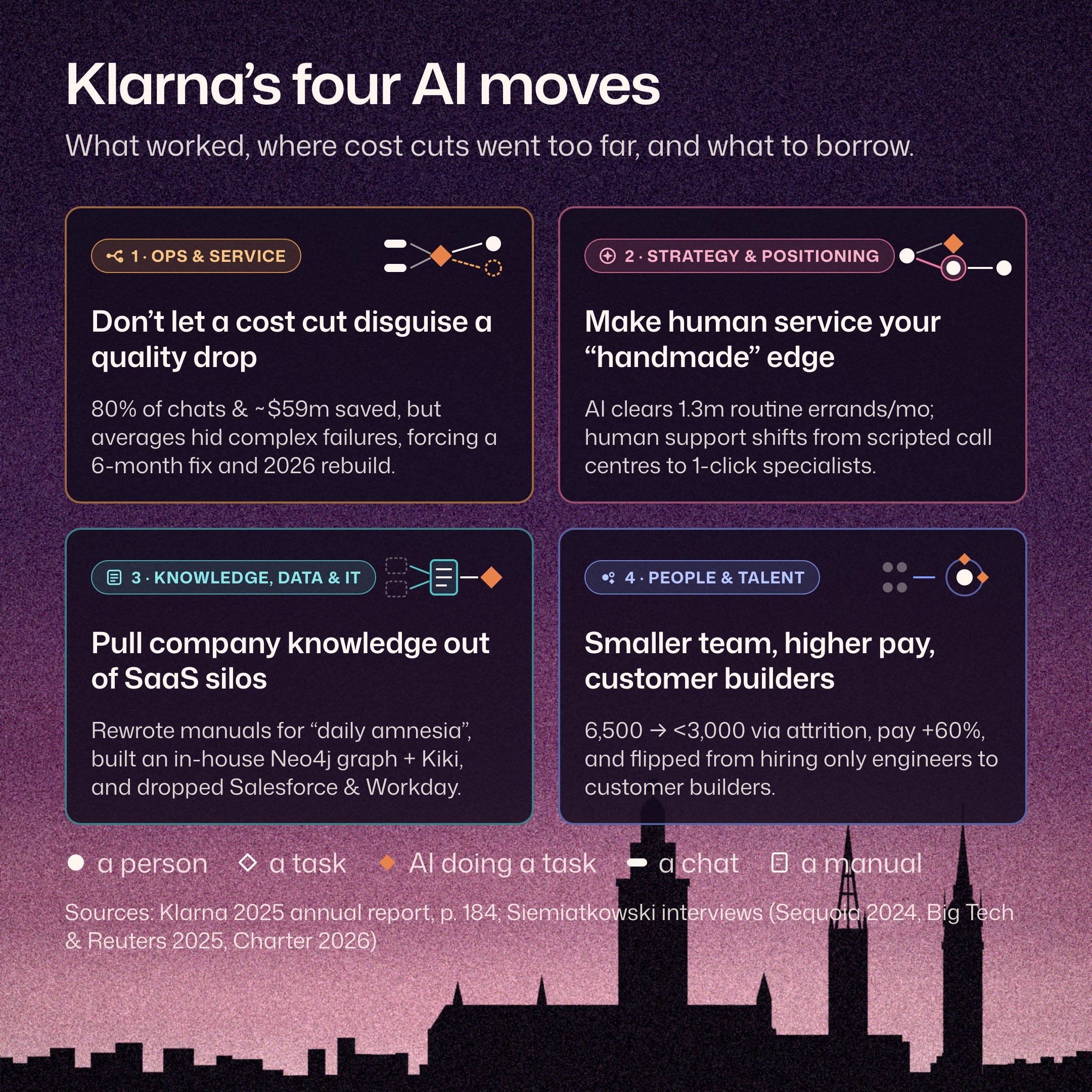
Ops & Service: Beware quality drop in cutting costs for AI. Klarna’s AI handled 80% of chats in 2025 (about 1.3 million errands a month, doing the work of 850+ agents and saving an estimated $59 million), but customer satisfaction was staying ‘on par.’ In turns out customers preferred the two-minute AI reply on basic questions and preferred a person on disputes and credit refusals, forcing a six-month course correction and a 2026 rebuild.
If AI makes baseline service cheap for everyone, where is your edge?
Strategy & Positioning: Make human access your “handmade” VIP tier. Once every competitor has a fast bot, keeping people one click away for hard cases and high-value relationships becomes a great differentiator. Klarna rebuilt its human tier around product specialists and kept its 50 retail partner teams (working with brands like Nike, Sephora and Macy’s) human.
Why did early AI answers fail, and what did Klarna build instead of SaaS silos?
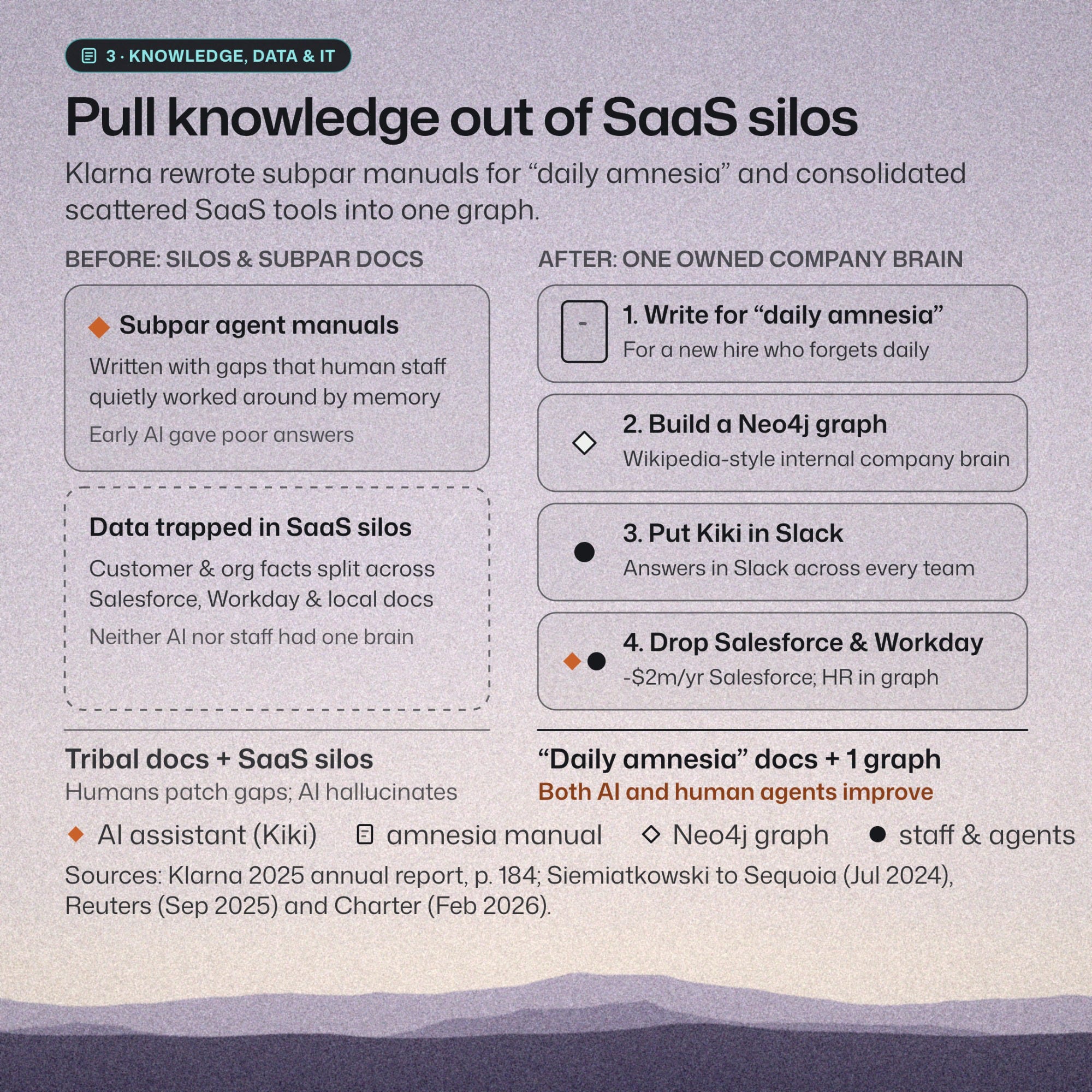
Knowledge, Data & IT: Pull company knowledge out of SaaS silos. When the AI gave poor answers early on, Klarna found its human manuals were subpar. Teams rewrote documentation for “daily amnesia” (as if for a new hire who forgets everything overnight), pulled scattered company facts into an in-house Neo4j knowledge graph with a Slack assistant (Kiki), and dropped Salesforce and Workday.
How do you shrink headcount with AI without breaking the front line?
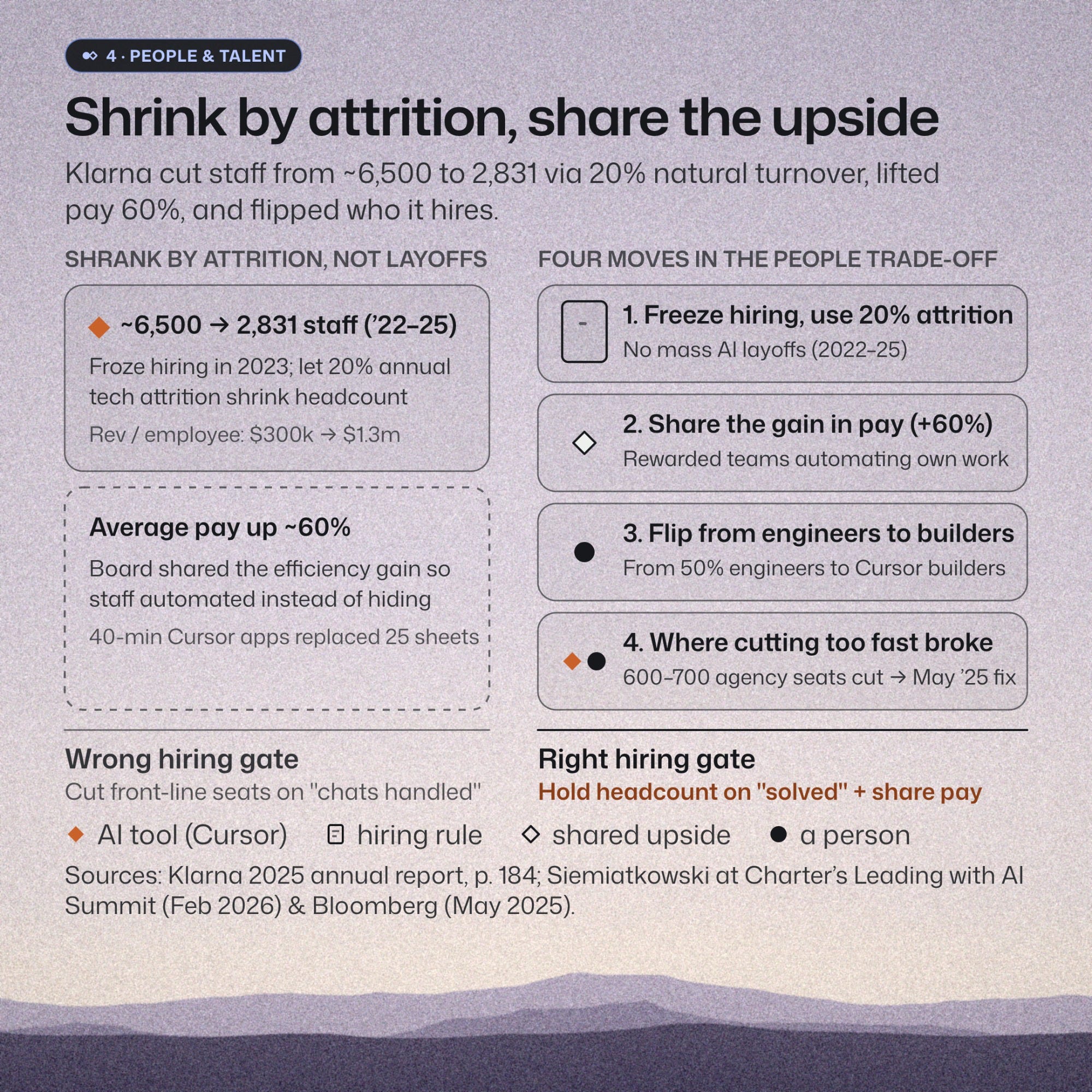
People & Talent: Shrink by attrition and share the upside. Klarna froze hiring and let 20% annual tech attrition take staff from about 6,500 in 2022 to 2,831 in 2025 without mass AI layoffs, lifting revenue per employee from $300,000 to $1.3 million and raising average pay by roughly 60%. Cutting outsourced support seats too fast still left complex queues short-handed.
Has Klarna’s AI strategy worked?
On cost and operating leverage, by its own account, yes. On customer service quality, it had to correct course. The 80% chat share and $59 million saving come from Klarna’s annual report rather than an independent study, and Siemiatkowski said in February 2026 that the AI support system is being rebuilt from scratch.
1. Ops & Service: When implementing AI, focus on quality, not just cost
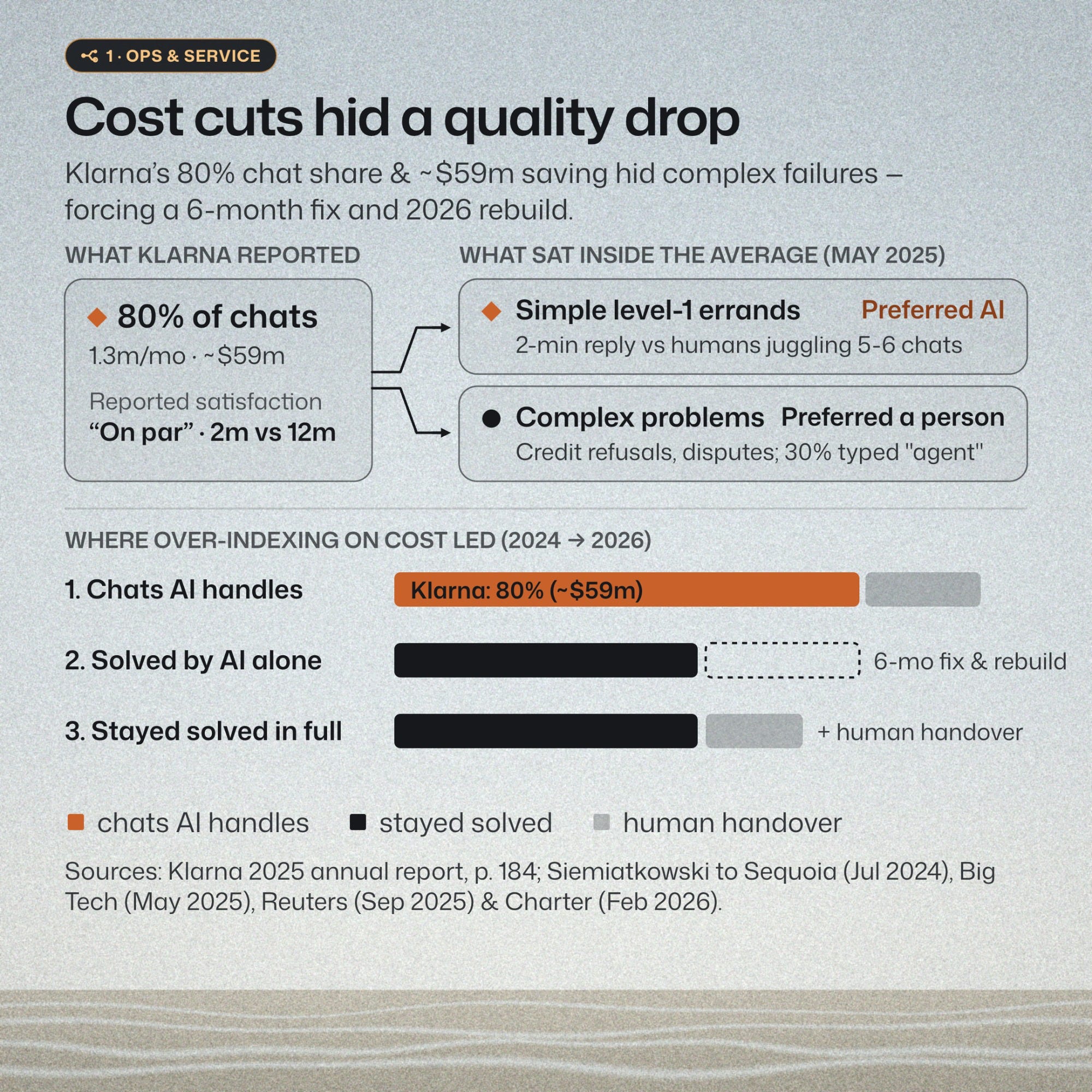
Klarna’s AI assistant actually started life as an internal tool, not a customer chatbot. On Sequoia’s Training Data podcast in July 2024, Siemiatkowski explained that Klarna’s dispute-resolution team built an internal retrieval co-pilot in two months, cleared its own backlog in two more, and only then opened it to customer chats. By 2025, it was handling 80% of chats, about 1.3 million errands a month, doing the work of more than 850 full-time agents and saving an estimated $59 million, with customer satisfaction reported on par with humans.
On the surface, this looks great, right? The business is handling more through AI than ever, getting more work done than ever whilst on par with human scores. But, then again, if more customers are having their problems solved, why are satisfaction scores only… on par?
On the Big Technology Podcast in May 2025, Siemiatkowski explained why.
Customers preferred the AI on simple level-one questions, like checking whether a payment had gone through, because it replies instantly while a human agent might be juggling five or six chats at once. On complex problems, however, customers preferred a person, and in its first year the AI couldn’t even explain why a shopper had been refused credit.
That’s why focusing on a single metric, such as “chats handled,” speed, or any cost-related saving, can often backfire. Cost-cutting or speed-driven improvements, when driven by AI, risk severe drops in output quality.
Indeed, on the day Klarna listed in New York in 2025, Siemiatkowski told Reuters that the company had “over-indexed” on cutting costs and spent six months correcting course, and by February 2026 he admitted his smartest people were rebuilding the AI support system from scratch.
So what?
Never judge an AI rollout on a single blended average or a headline cost saving. Certainly, never try to save costs just by implementing AI with a blanket policy. Routing work to the right parties is crucial; map your workflows so your team understands where speed is preferred vs judgement and empathy.
2. Strategy & Positioning: Make people your “handmade” VIP edge
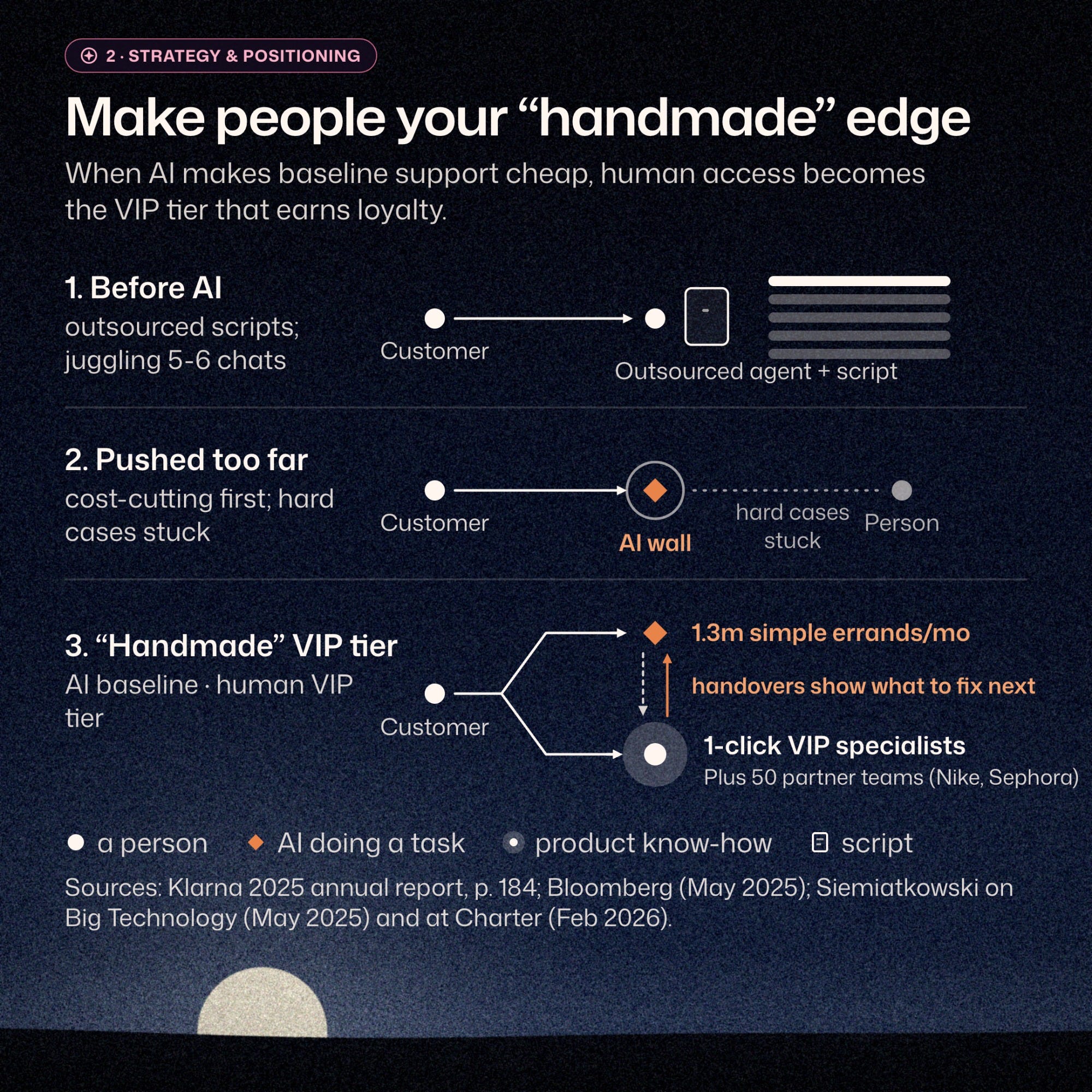
Before AI, Siemiatkowski told the Big Technology Podcast, Klarna had run customer support for cost: outsourced agents who barely knew the product answered from strict templates. When Klarna pushed automation too far, customers with complex problems were extremely frustrated and stuck behind the bot.
What’s more interesting is the strategic lesson Siemiatkowski drew from the backlash. When factories made machine-made clothes cheap, handmade goods became the luxury tier. At Charter’s Leading with AI Summit in February 2026, he argued that AI support is becoming the baseline every company offers, while human service becomes the VIP tier that earns loyalty.
So Klarna’s move in May 2025, reported by Bloomberg, wasn’t to go back to the old scripted call centres. Instead, it guaranteed that every customer can press a button to reach a human, kept the AI on the 1.3 million simple errands a month, and started rebuilding the human tier around people who actually know and love the product, including Klarna’s own customers working flexible remote shifts in an Uber-style setup. It made the same choice in B2B sales: across about 50 offices, the account teams managing retail partners like Macy’s, Sephora and Nike stayed human.
So what?
Ask where human contact in your business is just slow admin, and where it is the reason a customer stays. Find ways to use AI to automate admin tasks, but instead of treating that time as cost savings, map where it can be better spent to enhance the customer experience.
3. Knowledge, Data & IT: Pull company knowledge out of SaaS silos
All this is well and good but after implementing their AI chatbot the team found early on that the AI answers were falling short. Why? Because AI exposes every gap in how your company documents things.
In the Sequoia interview, Siemiatkowski explained that when the AI gave poor answers early on, Klarna inspected its internal documentation and found the manuals written for human agents were subpar. The staff had been quietly working around the gaps from memory.
To fix the AI, teams had to rewrite their manuals with a new rule: treat the reader like an employee who wakes up every morning with complete amnesia, so any person reading the page from scratch could work out the right answer step by step. Once Klarna rewrote its manuals for “daily amnesia”, both the AI and the human agents improved.
Klarna then applied the same architecture across the whole company. Instead of leaving company knowledge trapped across separate software tools, it built a complex in-house database (a Neo4j knowledge graph for you AI nerds out there) with a Wikipedia-style interface and an internal assistant, Kiki, that answers questions in Slack across every team.
Owning that single knowledge layer let Klarna drop Salesforce, saving about $2 million a year, and move HR out of Workday so reporting lines and org rules lived in the same graph.
So what?
Before you blame a model or buy another AI wrapper, inspect the manuals and data it reads from, the ‘context.’ Pick one workflow, rewrite its rules for a smart new starter who forgets everything overnight, and pull the underlying facts from scattered SaaS silos into one place that both people and agents can read.
4. People & Talent: Shrink by attrition and share the upside
The loudest argument around Klarna was about jobs. At Charter’s summit in February 2026, Siemiatkowski explained how Klarna actually managed its headcount: rather than running mass AI layoffs, it froze hiring in 2023 and let the tech industry’s typical 20% annual attrition shrink the company from roughly 6,500 people in 2022 to 2,831 full-time staff in 2025. Over that stretch, he said, revenue per employee rose from about $300,000 to $1.3 million.
To stop staff hiding their workflows out of fear, Siemiatkowski made two trade-offs explicit. First, he told employees plainly that AI would shrink total headcount through attrition. Second, he got the board to reinvest a chunk of the efficiency gain into compensation, lifting average pay per employee by roughly 60% over that period.
He also flipped who Klarna hires: after two years of hiring only engineers until they made up half the company, Klarna now hires business people who understand customers and can build with AI tools like Cursor themselves (one non-engineer built an app in 40 minutes that replaced 25 regional onboarding spreadsheets).
Where that attrition play went wrong was on the customer front line. Switching off about 600 to 700 outsourced agent positions at once while freezing internal hiring meant that when complex cases piled up, the remaining service felt thin, forcing the May 2025 recruitment drive for specialist human agents.
So what?
An AI hiring gate only works if people see the upside of automating their own drudgery and if customer quality holds. If you hold headcount flat while volume grows, share part of the margin gain with the team building the workflows, and never cut front-line capacity (e.g. as per their “chats handled”) before the solved rate is proven.
What does all this mean?
Klarna is (so far) a success story despite the headlines because it learned from its mistakes. Although initially over-eager to use AI instead of humans, the company now realises how much balance can be achieved by using humans for more complex tasks while enabling AI to handle simpler ones.
Just like we’ve seen before with Shopify and Stripe, data foundations are paramount, but what’s new this week is the importance of handling metrics correctly. AI implementation for the sake of cost-cutting must be handled with extreme caution, if handled at all.
Let’s not forget that a company that uses the time saved by AI to cut costs might put itself at a disadvantage compared to a competitor that reinvests that time to create a better customer experience.
For Further Exploration
Klarna Group plc 2025 Annual Report (Form 20-F, p. 184) (Klarna, March 2026, company-reported figures)
From the Frontier: Lessons from Klarna’s AI Rollout (Sebastian Siemiatkowski on Sequoia Capital’s Training Data podcast, July 2024)
Klarna CEO on AI Customer Service and Why Complex Cases Need People (Sebastian Siemiatkowski on the Big Technology Podcast, May 2025)
Klarna Turns From AI to Real Person Customer Service (Bloomberg, May 2025) and Europe’s AI poster child Klarna taps brakes on chatbots (Reuters, September 2025)
Klarna CEO: We’re Giving AI More Customer Support Work (Sebastian Siemiatkowski at Charter’s Leading with AI Summit, February 2026)
Related Wayfinder breakdowns: Shopify’s AI strategy, Stripe’s AI strategy, how Ramp got 800 people building with AI, and Duolingo’s AI strategy. Browse all Company Breakdowns.
Cheers and see you in the next one,
James