

Utopia: The Case for Hope
Not enough people are asking the question: how might it all go right?

“I must not fear. Fear is the mind-killer. Fear is the little-death that brings total obliteration.”
Frank Herbert, Dune (1965)
I wanted to talk this week about the elephant in the room I’ve been seeing the past few months: the Fear and Hatred of AI.
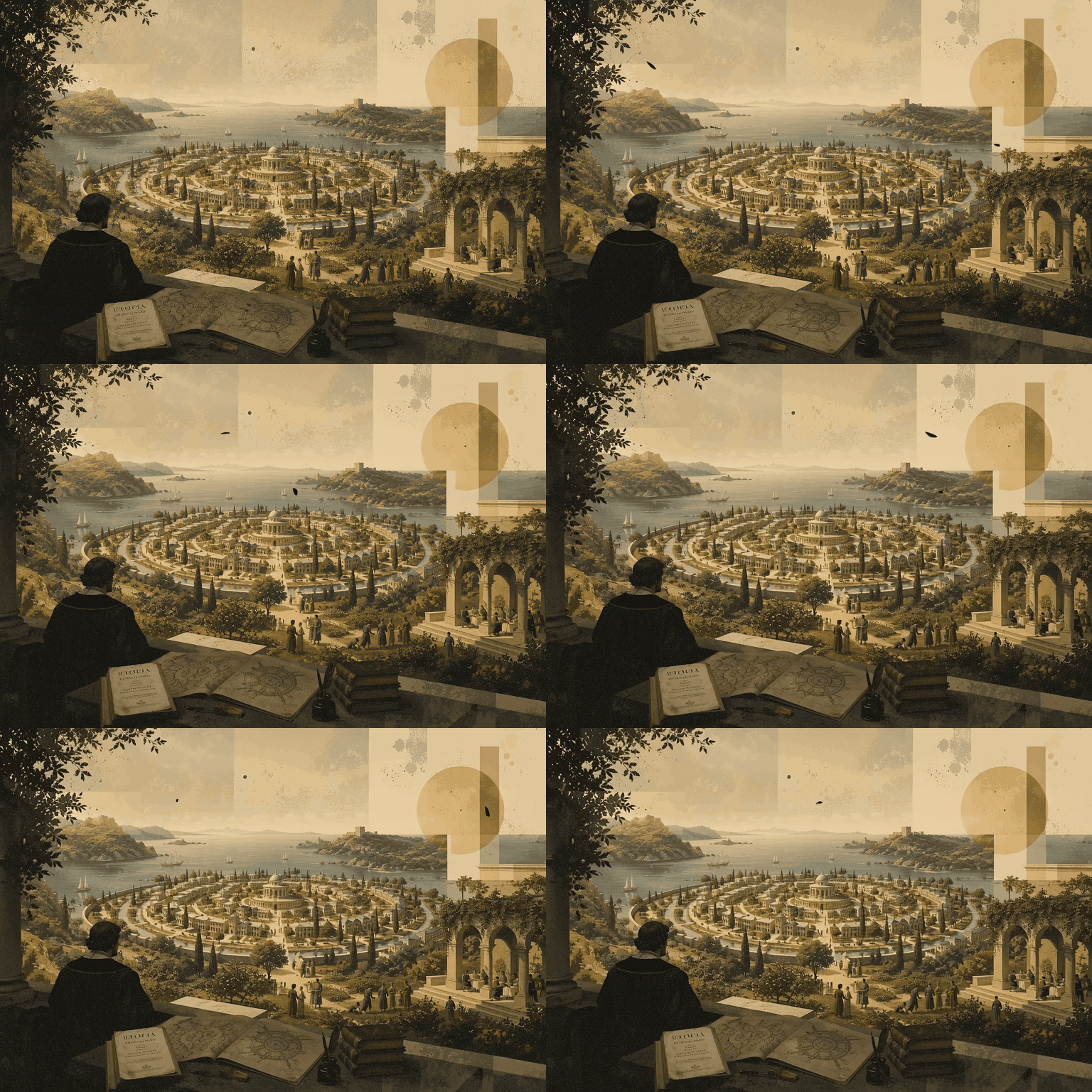
I grew up in a corner of London that once belonged to Sir Thomas More: Henry VIII's right-hand man, a scholar, a devoted family man, and above all an idealist. If you've ever used the word Utopia, he's the reason it exists. He coined it in 1516, from the Greek for "no place," a sly pun on "good place," to describe a society better and kinder than the one he lived in.
But the idea captured the imagination of generations: hope for paradise on earth.
Fear and Loathing
First, the fear. There's a fair bit going around.
On 15 May, in Tucson, Eric Schmidt stood up to give the commencement address at the University of Arizona. He mentioned AI, and the booing started. "I can hear you," he said over the noise. "There is a fear." He wasn't alone this graduation season. At the University of Central Florida, a speaker called AI "the next industrial revolution" and the crowd erupted before she could finish the sentence. At Middle Tennessee State, the chief executive of Big Machine Records was booed for saying AI is rewriting how music gets made. His answer, "deal with it," felt like kicking a hornet’s nest.
So as tech leaders (hopefully not overlords) become more entrenched in the face of resistance, the graduates can see the harm coming, and they want, reasonably, the right to refuse it. The fear underneath is real: a sense that the ground is shifting, that the future is being handed over already broken.
Some say this is the AI industry becoming a victim of its own success. Fear-mongering as a tactic for marketing and fundraising. I’d agree.
Those in the world of tech like myself (and most likely you reading this) live inside a bubble of people who mostly see this the way we do, and online it only thickens. I scroll between clips of the booing and clips of people building wonderful things. Anxiety and excitement are two sides of the same coin.
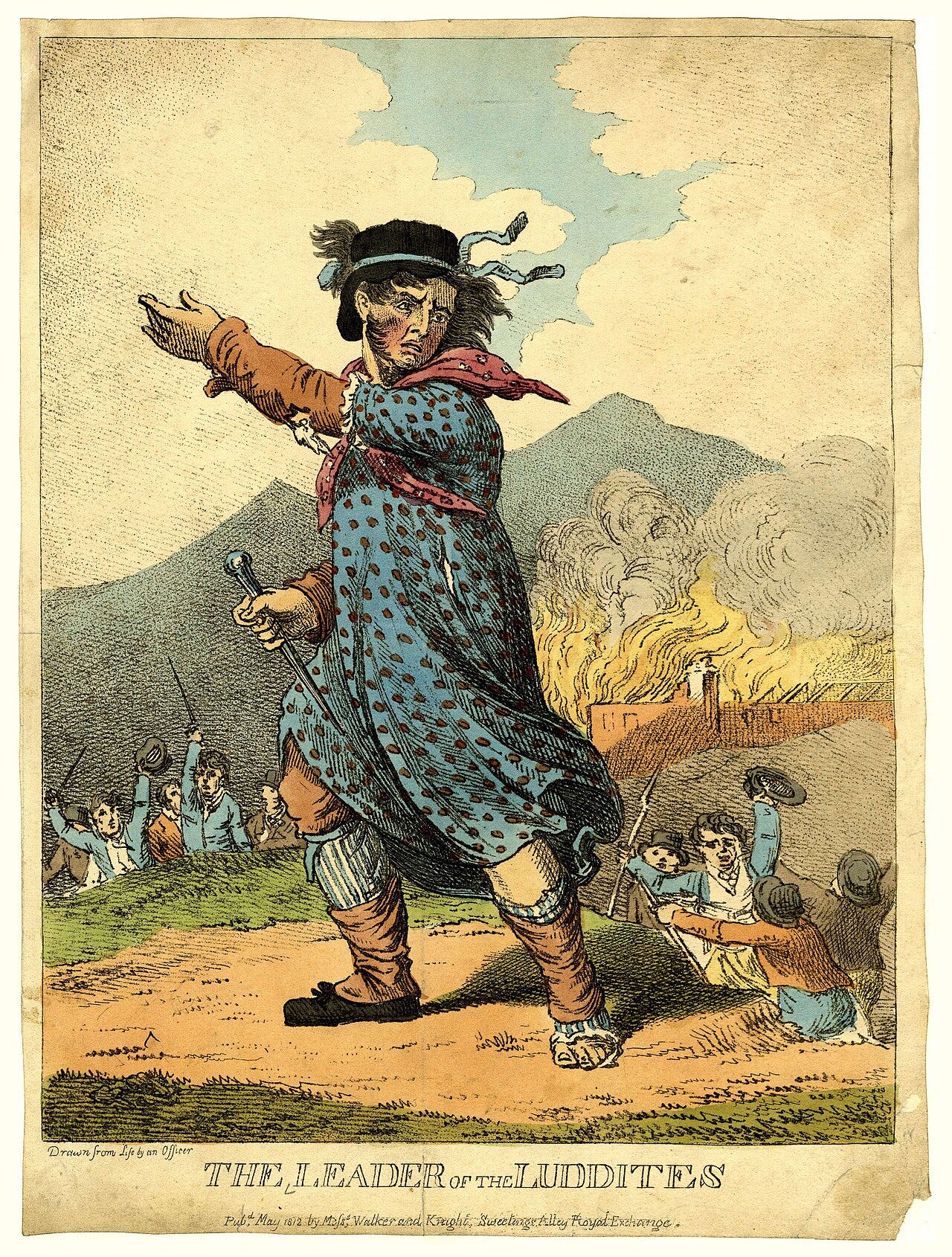
Those Luddites we remember vaguely from school or from old-fashioned insults. They knew the feeling. In Nottingham in 1811, they put hammers through the loom machines that had just been installed to replace them in the factory. We use their name now for anyone too dim to see the future but I always thought that a bit unfair. They saw it perfectly well. They saw that their livelihoods were at stake, and they were right to some degree, they were just wrong on the assumption that it would permanently take their jobs. Sure, fewer were needed per factory but more factories popped up and then people were still needed to man the new looms - others to fix them when they broke, to clean them, etc. This is because the loom is just a tool, with limitations that need to be addressed by humans in order to achieve an outcome.
So, the fear was and is not stupid. But a fear can be honest and still be aimed at the wrong thing, the steel man that draws attention.
Looking for the Wolf in Sheep’s Clothing
Look, we’re pattern-finding animals; it's our oldest trick. We see faces in clouds (pareidolia) and meaning in static (apophenia), and we read intent into anything we can't place. Who hasn’t tried to spot how dogs are similar to their owners. That wiring kept our ancestors alive: the rustle in the grass was a predator until proven otherwise. But the same wiring has a failure mode: the genuinely new - the black swan event. We rarely examine the new thing first for what it is. We watch it talk like us and reason like us, and being built to do more like us… so it must be just like us, right? Even acclaimed Historian and Author Yuval Noah Harari suggested we stop calling it artificial intelligence and start calling it alien intelligence.
Ghosts, Not Animals
However, LLMs are machines of mimicry. The people building these systems know more than anyone that logic deserts them in peculiar ways: the classic one is the model insisting you should walk, not drive, to the car wash 50m away. Anyone who uses LLM tools a lot understands that they have extremely jagged intelligence (just try writing with one, it’s mostly awful and most can tell).
Andrej Karpathy has the sharper mental model: we are treating LLMs as if they are animals, when in fact we are summoning ghosts. An animal is the work of evolution, shaped by hunger and weather and death across millions of years. A ghost has no ancestry at all. It is conjured, distilled out of very nearly everything we have ever written down: our science and our slander, our love letters and our comment sections. It has us. The best of us and the worst of us, averaged into something that can finally answer back.
LLMs are Tools, Map the Boundaries
The hugely disruptive thing about LLMs is that they give those who have no ability within a subject to at least get to average. The floor has moved, and it’s moved more rapidly than anyone could ever have predicted. We can only assume that it will move even more rapidly from here. Experts will train different models to be even better than the average in many departments (as they’ve done with Claude’s Fable 5).
At the end of the day, however, these are still only tools. Brilliant tools no doubt, but just like the looms needed managers, cleaners, and repairers, we all need to learn how to best use them. Why? Because LLMs do not think or reason unprompted… They have gaps that their training data hasn’t covered and might never cover (as Yann Lecun likes to stake his career on).
These tools lack a true heartbeat, a true mental model of the world, and a true intent for life.
This isn’t a prediction, nor a pitch from inside my bubble. I just implore readers to balance their focus on some leaps of imagination: how might it all go right? How might I help more people than ever with these tools? What if we all used these tools to create and contribute to a better collective future?
Ready, Player One?
And I’ll leave you with something I’m writing more on next week as it deserves an essay of its own, but in summary: these tools may put some of us out of work temporarily but I strongly disagree with anyone who thinks they’ll force us to stop working any time soon. Most of us are about to work more than ever, but the work will increasingly feel game-like in ease.
Ask anyone who uses Claude, Codex, Gemini (albeit not often), or open source LLMs etc. to solve real problems. The queue of problems doesn’t shrink as the tools improve; it grows, because problems that weren’t worth attempting suddenly are (as I explored in my piece on the Long-Tail of Opportunity). There has never been more worth tackling, and there have never been better means to tackle it. So people are up late, more than ever, not because anyone demanded it, but because the thing they’ve always wanted to fix finally looks fixable.
I don’t think AI ushers in the age of leisure any more than the age of redundancy.
Everyone works more, not less. The work gets more stimulating, more enjoyable, but simultaneously more tiring. The lights aren’t going out. They’re staying on later.