



“Over himself, over his own body and mind, the individual is sovereign.”
John Stuart Mill, On Liberty (1859)
I recently tried my hand at building an app I gladly pay for.
Flipping the Bird
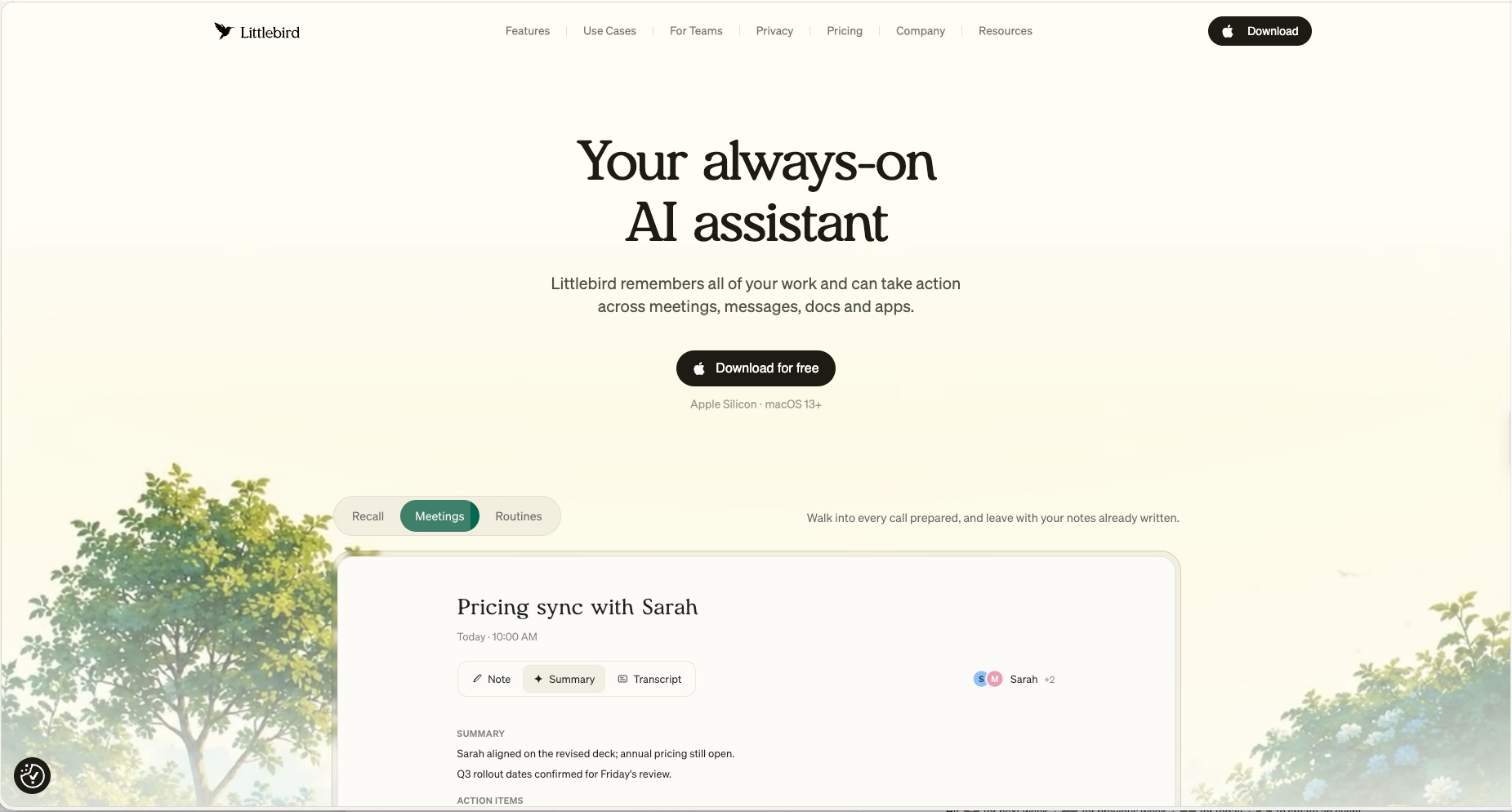
Those of you who know me well know I appreciate it when technology and design marry well. So, needless to say, I’m a huge fan of a desktop app called Littlebird.
Littlebird captures text from the active window on your screen throughout your day, building a searchable picture of your work.
You can ask its AI at any point: “What did I do over the last few hours?” “What was the thing I left out yesterday from my to-dos?”
Its main virtues are that it helps you to never forget, like a little bird on your shoulder.
As an advisory, we do most of our work on our laptops. So I personally find it very useful for everything from recall and initial context prompts for new chats with ChatGPT or Claude to email writing, remembering details from the last meeting, and even daily summaries for retrospectives. It saves me a LOT of time and begins the feedback loop of improving our processes as a company.
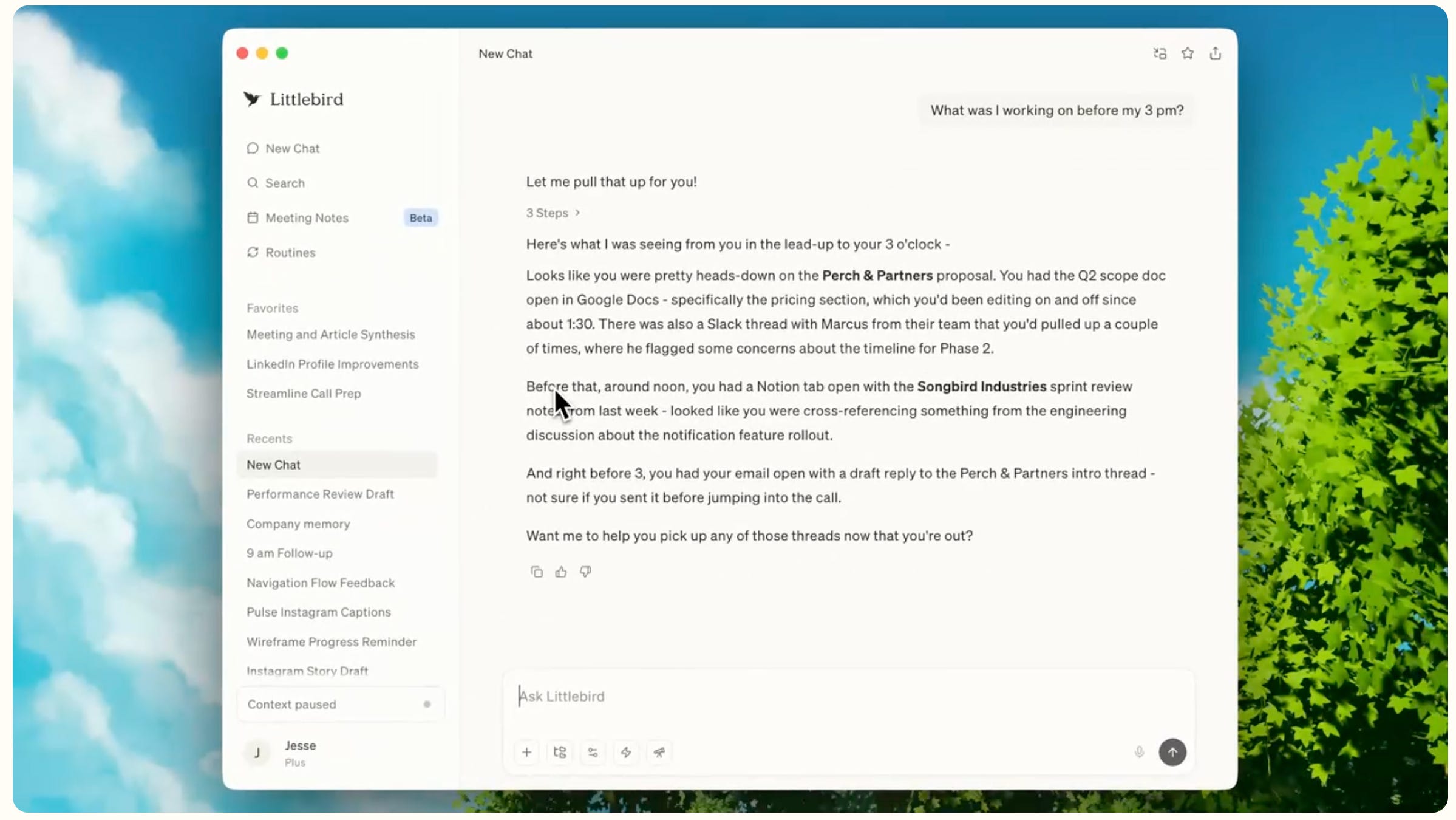
For any business wanting to be ‘AI-native,’ context like this is foundational. In fact, this provides such a foundational layer that it is also the same direction ChatGPT is now taking with its new Computer History feature.
But the issue is that this searchable record can include my clients’ details as well as my own.
Stop the Record
Littlebird says it encrypts stored data, undergoes independent security audits and does not use private data to train its models. Great, and I do trust the Littlebird team are extremely talented, honest and have and will continue to take every precaution.
(And unlike other recent AI startups from SF, they don’t claim to have perpetual, irrevocable access and use of your personal data, e.g. Instinct AI)
However, the threat those protections face is changing rapidly.
Most of us have seen the news.
Advances in AI are rendering most cybersecurity defences alarmingly out of date. We can see the smoke signals: from Anthropic’s Project Glasswing that uses AI to f, which uses AI to find and help fix vulnerabilities, to the dire new threats in Hugging Face, which seem to show only the tip of the iceberg of what’s actually going on.
The recent statement by Palo Alto CEO Nikesh Arora summarises the picture well:
“Nothing that was deployed 7-10 years ago is ready to handle AI.”
Now, critics will say this is great marketing: “You shouldn’t believe it; they all have a vested interest in making these statements.” That is true, but independent evaluations also agree that this is very, very serious.
The main issue now is that cloud services keep their data concentrated for operational efficiency and security. That’s been great for the last 10 years, but ironically, in the coming age of AI, it also means a larger target. One particular reason: Concentration creates exposure - like a giraffe in a field of sheep.
It’s the same reason why the ‘Godfather of AI’ Geoffrey Hinton now spreads his money across three different banks. Diversification of risk is a phrase that now needs to be used for our data, not just our finances.
Data Sovereignty
Palantir’s Alex Karp recently argued that businesses should retain control over the data and knowledge that give them their advantage.
Now, there are many things I may disagree with Mr Karp on, but this is not one of them. I would just go further: People, too, should increasingly think of themselves as businesses in this regard.
For me, data sovereignty means having a meaningful say in what gets recorded, where it is processed and who can access it. As agents take on more work, they also have to decide what they are allowed to do with it.
Yes, keeping data on my own equipment gives me more responsibility in securing and maintaining it, but it also means that, for the extremely important data, I’m reducing my exposure. Make no mistake, larger businesses will soon feel this on a larger scale and receive more pressure from clients in this regard.
The growing cyber threat posed by AI makes it increasingly necessary to bring these records under our control, not least as a courtesy to our partners and clients.
Build versus buy
Hence, I wanted to build my own Littlebird (obviously taking care not to copy their proprietary user interface).
I planned the architecture and directed agents to compare their work with Littlebird. I set them going over the weekend. After about a week of work and monitoring, we had a first version:
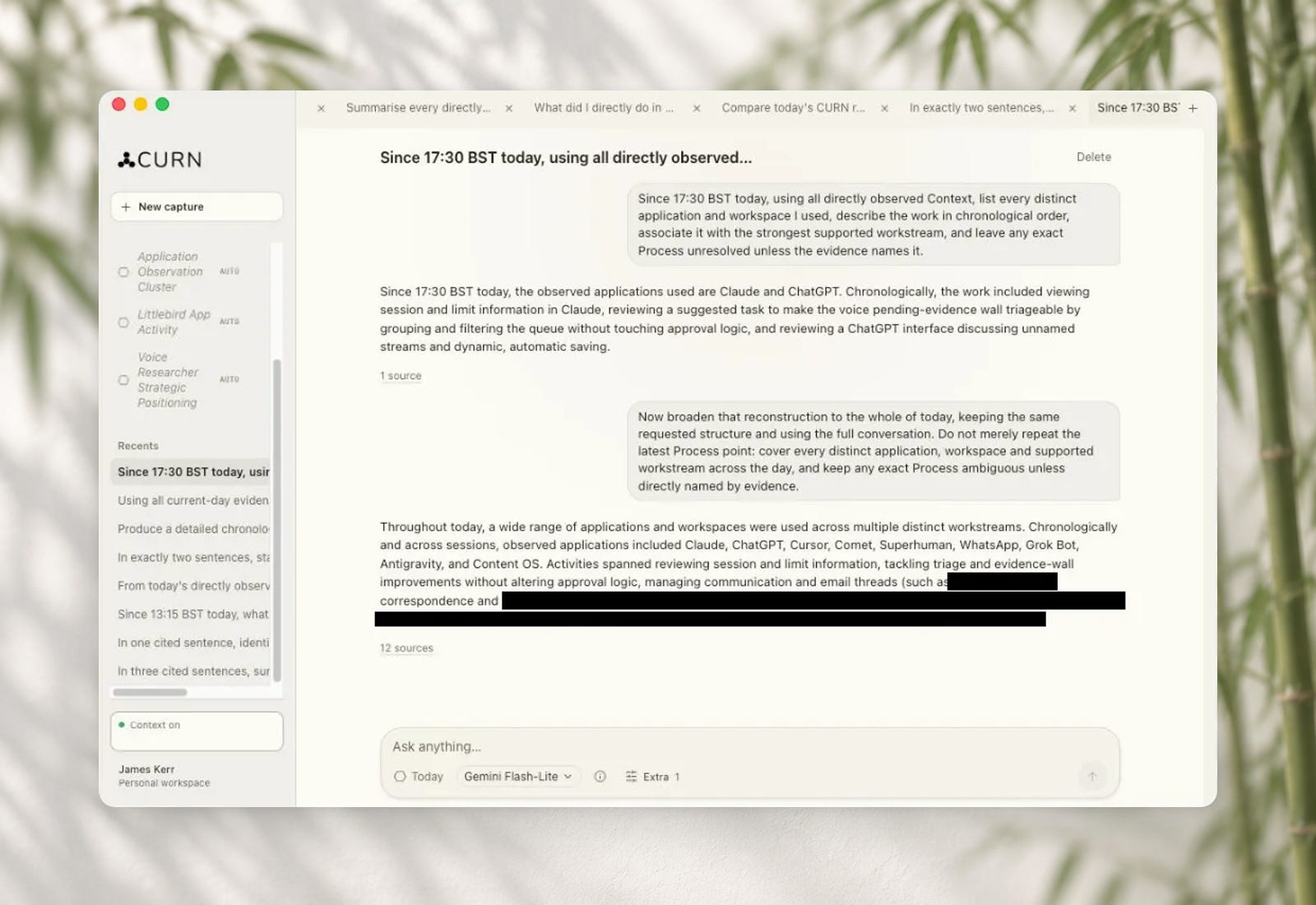
Getting a first version working
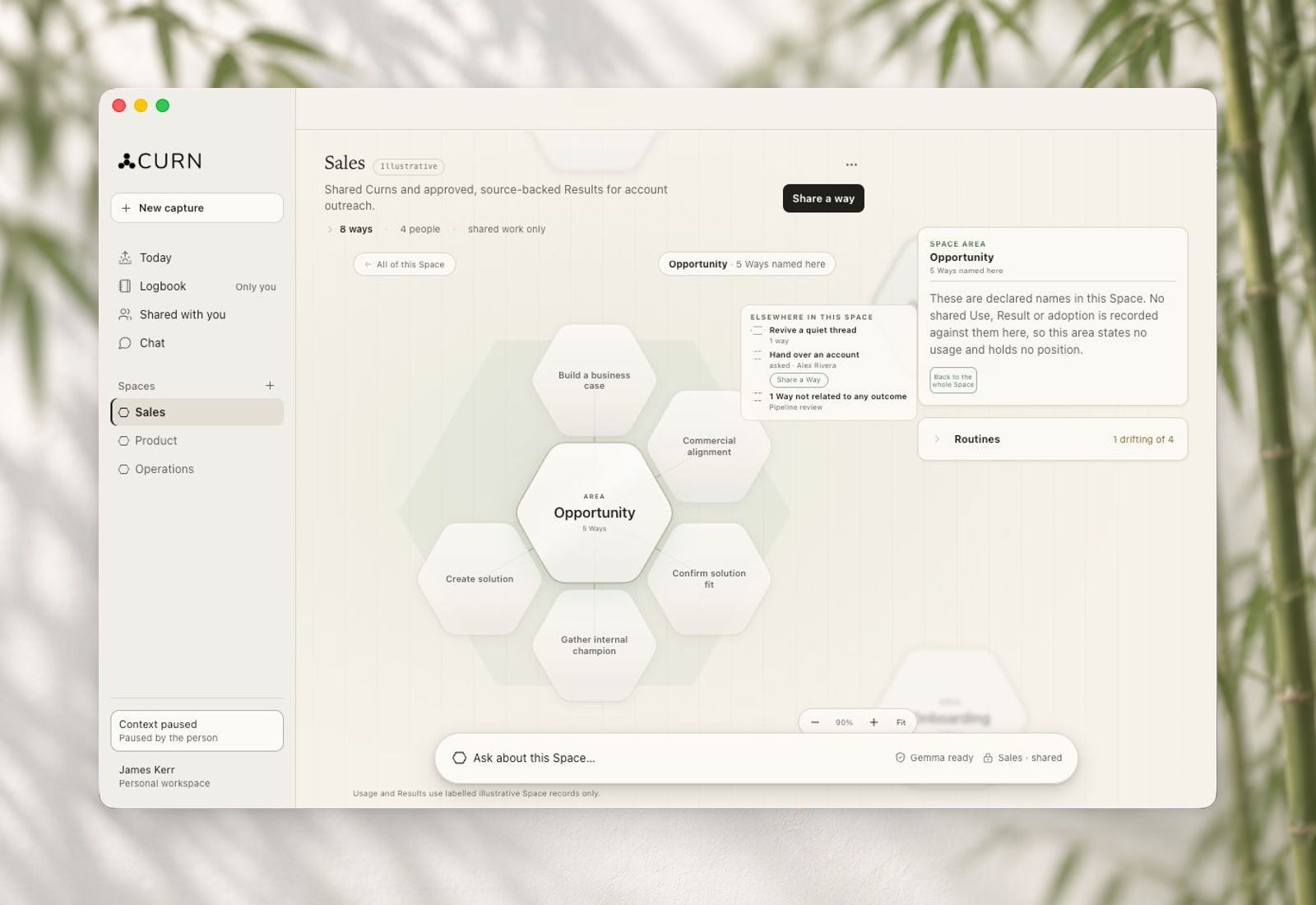
Automatic Capability & Process Mapping
Now, make no mistake, this is a technically very complex app from an extremely talented team. However, I knew the rough technical architecture that built it. And I also knew how to manage agents in order to recreate it. And this was only a personal project, without the need to worry about the scaling issues that most SaaS companies and businesses face… but then again, most companies won’t need to worry about that if they build their own.
The concept of build vs buy is a familiar choice in business; it usually refers to the choice between adopting an existing product and building something to meet your own requirements. Commissioning a developer or directing agents still counts as building.
The trade-off usually says buying means paying for a product someone else develops and maintains for many customers. Building gives you more say in what it does, with testing and upkeep in mind. You can also combine the two by extending a product or building around a service you continue to pay for.
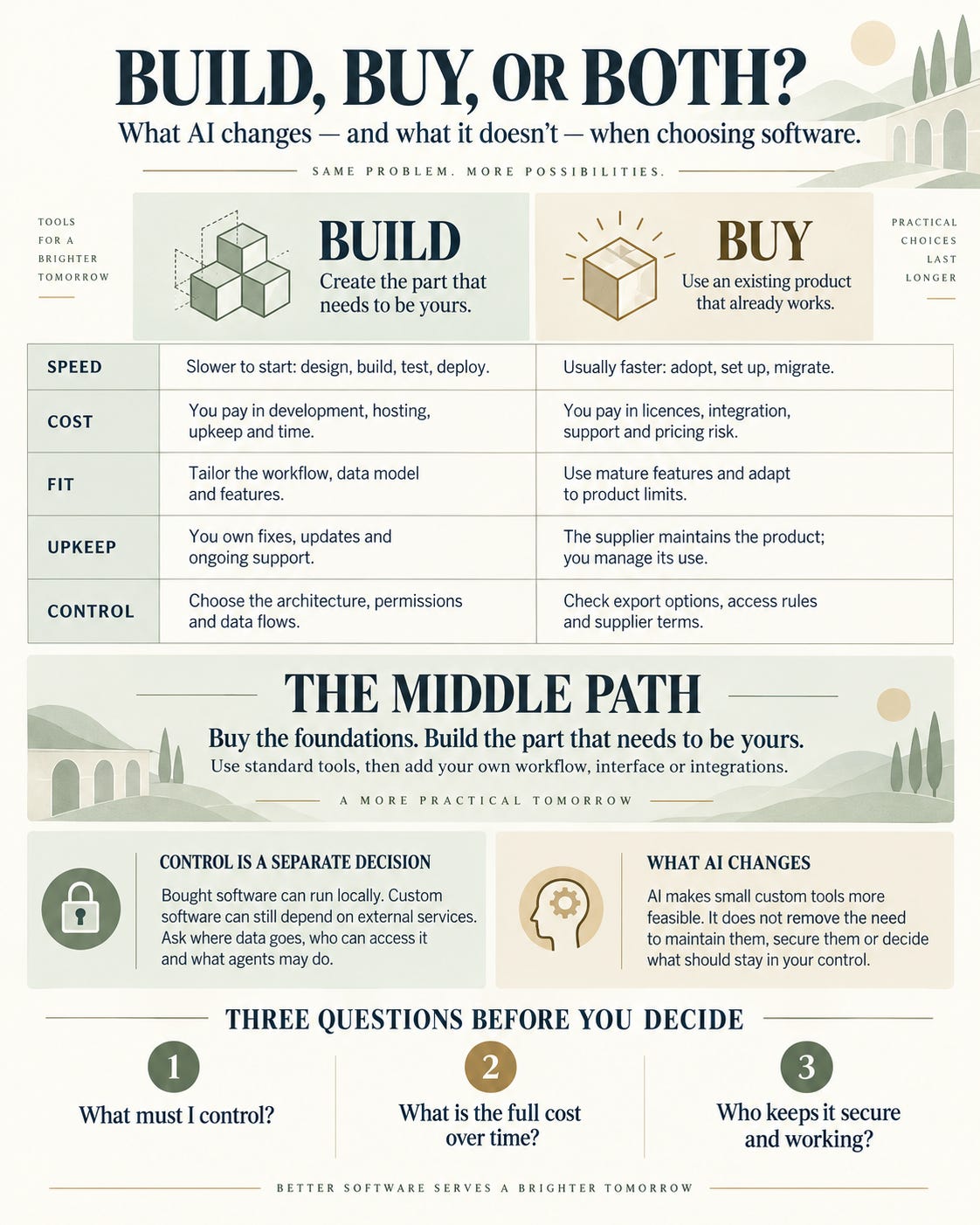
However, this classic trade-off, as seen above, is changing. The attraction of build is growing. You should see my experiment and needs as an early microcosm of the choice faced by larger companies.
The Personal Conglomerate
Customers take over work from their suppliers regularly.
For example, until 2012, Netflix delivered its video through commercial content delivery networks. It then introduced Open Connect, its own network designed specifically to deliver Netflix content.
Netflix only needed to serve its own requirements. Its scale made that investment worthwhile. My experiment raises the question of how far AI can bring that choice within reach of smaller businesses and individuals.
This isn’t to say that everything will change overnight.
In his February 2025 interview with Dwarkesh Patel, Satya Nadella discussed the difficulty of changing how people work. A company replacing a shared system has processes, colleagues and existing commitments to bring along with it.
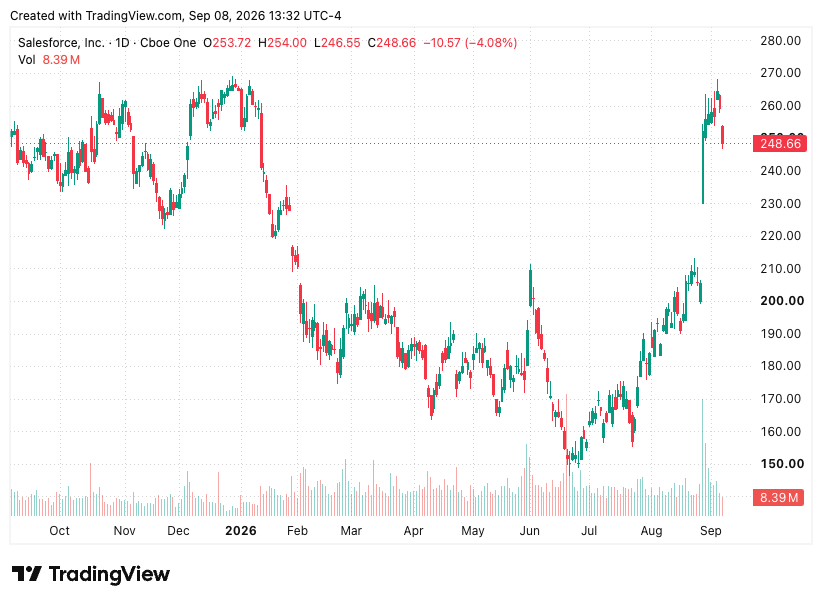
A share price reflects expectations. Meanwhile, Salesforce’s August results showed 11% year-on-year revenue growth, including a contribution from its Informatica acquisition.
The business hasn’t evaporated because customers can generate code. I don’t see an inevitable SaaS apocalypse, especially not for entrenched teams. The forces of regulation, sheer inertia and risk of data protection mishaps are too strong (for now).
The problem is for the new start-ups. Where does this leave future software subscription business models? Most large businesses and narratives consider data their most durable asset.
A subscription to what?
Well, I’ll take my personal experience as a signal.
You see, I say all this, and yet I will still gladly pay for Littlebird.
Why? Because I’m paying for the promise of the future as well as for what it does today. Building something for my own needs hasn’t stopped me from wanting to support and see what their team makes next.
As a business owner and personal user, I don’t want to always maintain these systems or plot the path. Even if AI can help, it’s an opportunity cost I don’t want.
What I want is a harness that is consistently updated by a talented team of visionaries who understand where to take design and technology from here. The ownership of the data, however, and the choice of what happens to it should remain mine, preferably within local or distributed systems depending on the level of privacy and safety I need.
There is a precedent at Red Hat: its customers can redistribute the software while paying for subscriptions for maintenance, configuration support, and updates. For me, that might mean helping clients use this technology to better understand their processes while maintaining greater control over their records.
So what?
Start with one product you depend on. Where does your data live? Can you move it?And what access have you given people and agents?
If you’re building a business in software, look at what customers copy, change and still buy. That reveals your value and what your roadmap may have missed. Test offers related to setup, integration, security, or upkeep.
If you’re investing, ask yourself: what keeps customers subscribing when they have a credible way to build it themselves?
The major opportunity here will be in making data control convenient. All it will take is a few more highly publicised agentic hacks for the demand to come flooding in.
I think this topic and your take of DIY development is super interesting!
I've been wondering whether digital products might soon gravitate toward a recipe-type future. Where in the same way that chefs create recipes, or knitters sell stitch patterns, there's a world where devs create/recreate an app like you did, and then fold all of their conversations into an instruction manual for anyone else's AI to follow.
I'd be eager to hear your take on that, James, do you see that as being a realistic possibility?
Great article! And such a good point that while you can build it now, you won’t be focusing your fulltime energy and efforts on evolving it.
Always and even more increasingly how and where we deploy our energy and towards what problems / solutions matters so much - when we technically CAN build almost anything.
Thanks for sharing - very thoughtful.