



Hey ,
Thanks for reading.
After reader feedback, I’m making The Wayfinder Notes sharper and more useful.
Every Thursday: a 4-minute breakdown on a company’s AI playbook, why it made those moves and what we can learn about business strategy in the age of AI.
I started this newsletter to help people make sense of where business is heading, like the wayfinder navigators of old on the seven seas. Looking for lessons from real business case studies seems as good an anchor as any. (This is a Pandora’s box of seafaring puns)
My longer thought pieces will still come through every so often as an add-on value.
With that, let’s dive in. (last one)
TL:DR:
Adopt outcome-led principles: test why you can’t reach the same outcome with AI
Building a business data foundation is core to your unique competitive advantage
When creation is cheap, value moves to knowing how to check
Map how customer behaviour is changing, act quickly make sure you stay useful
Shopify
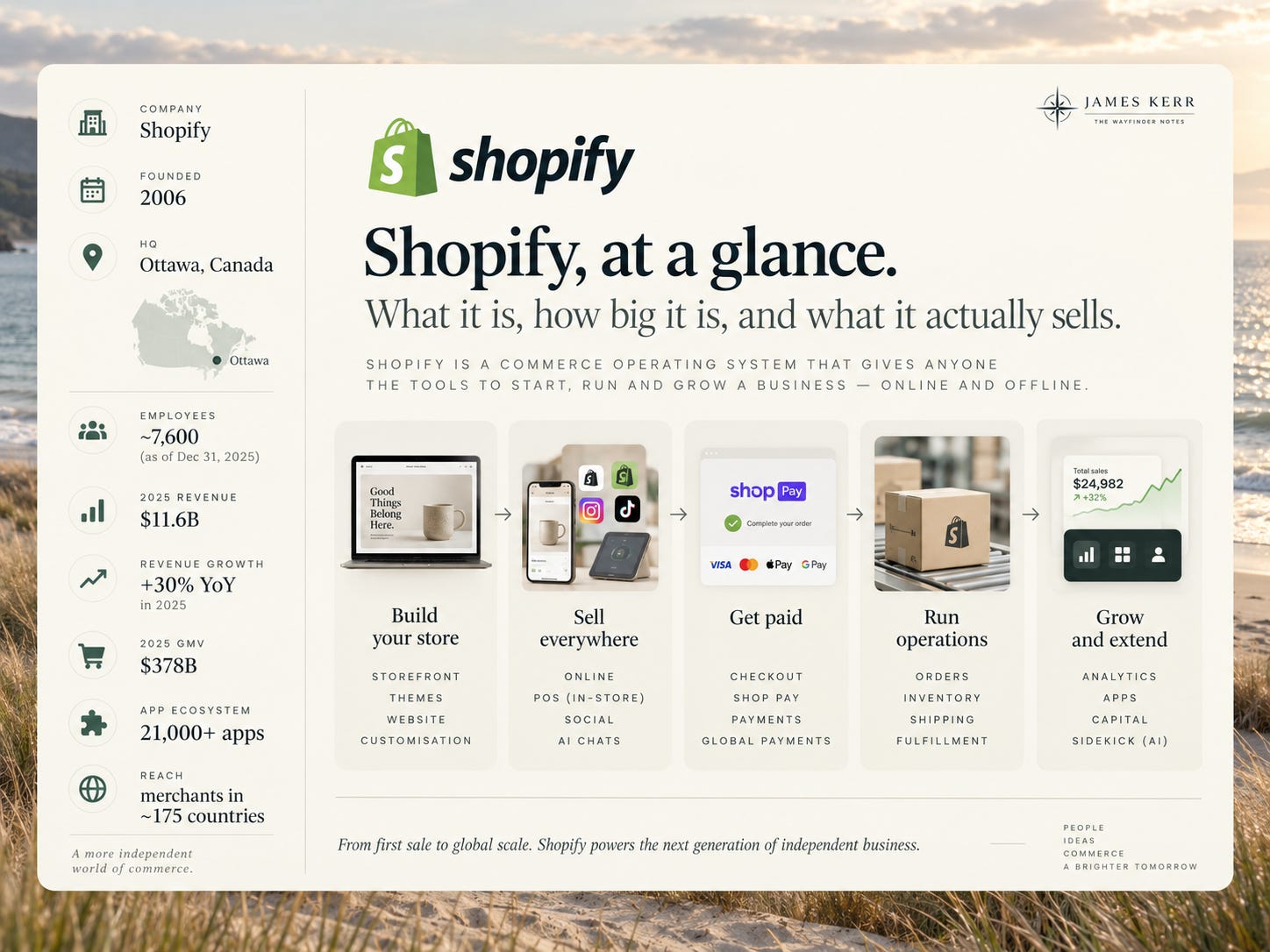
For anyone on the AI or Tech circuit, you’ve heard of Shopify’s Founder/CEO, Tobi Lütke.
He is the embodiment of the AI early adopter CEO persona:

So it’s fitting to start this series with Shopify; a company that has thrown itself into AI adoption headfirst.
1. Be Outcome-led
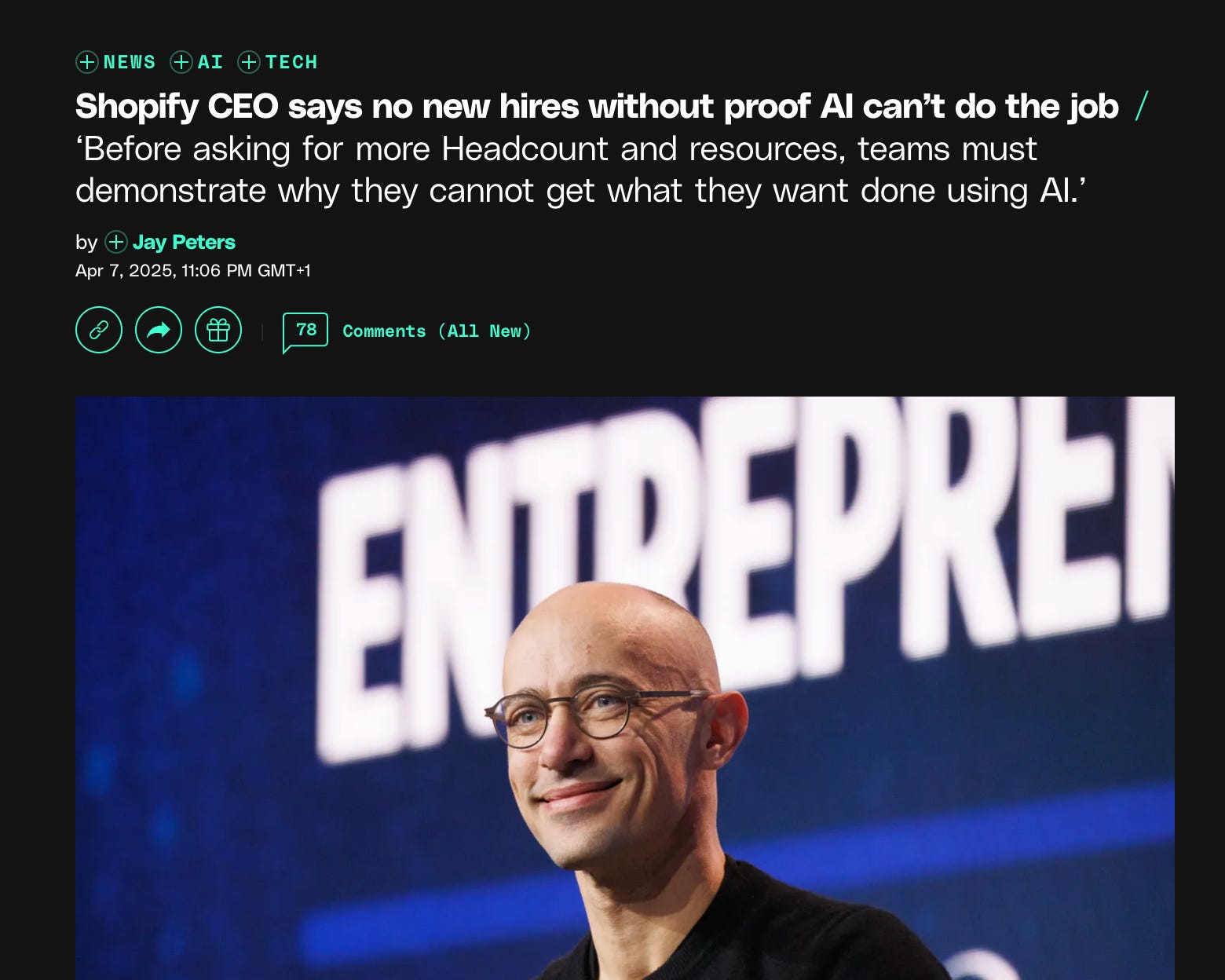
In April 2025, Tobi Lütke asked his teams to explain why AI couldn’t do the work before asking for people or resources.
Lütke understood the need to encourage all his employees to move into AI, setting his principles for experimentation from the start (as per this self-half-leaked memo):
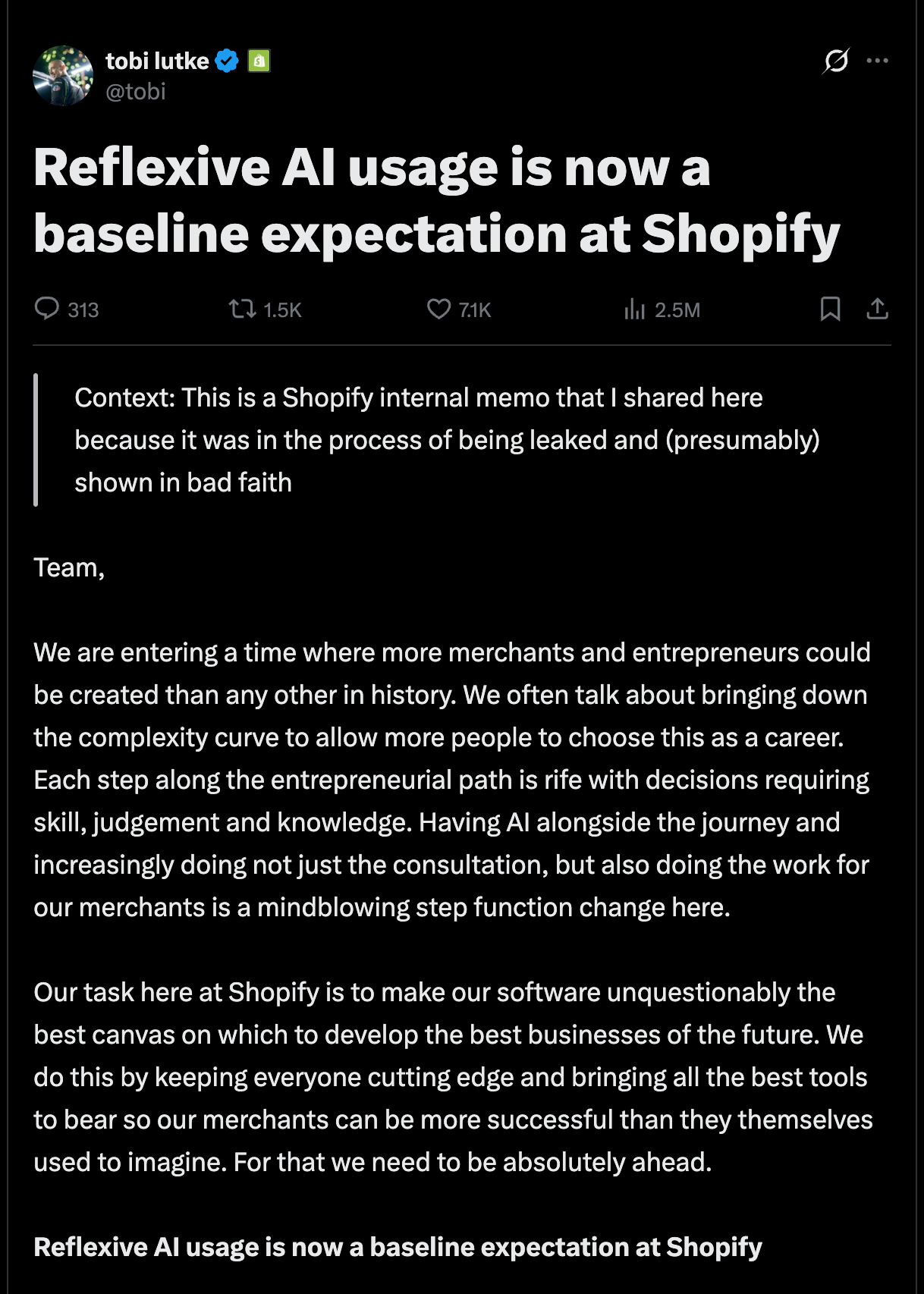
His fifth principle: “Before asking for more headcount and resources, teams must show why they cannot get the job done with AI.”
This was the crucial tactic for getting safe adoption of AI.
It’s all well and good to have a techy CEO give you some directives from on high, but this was a forcing function to introduce AI effectively, slowly, and in a problem-led manner.
Why? Because if you need to prove you do not need AI, you have to be crystal clear on what you are trying to achieve.
A scientist is trained to disprove their hypothesis, to challenge their own idea. This is exactly the mindset change and cultural shift that lends itself to better AI Adoption.
Say I am leading a merchant sales team at Shopify, and we are over-forecasting demand for the customer success team because sales has been too hot. I used to just ask HR for another customer success manager. Now I need to prove I do not need AI.
My first move is to define the outcome (e.g. “we need new customers set up within 2 days”) and what success looks like (“at least 80% of customers satisfied”), so I can test against it and prove it is unnecessary. That makes the goal clear for both the team and me.
Other companies have tried tying financial incentives to experimentation and calling it a day, but that does not work and can create strange side effects (see Tokenmaxxing at Meta).
The prize for all this? AI is introduced based on outcomes by those closest to it and best informed about the problems.
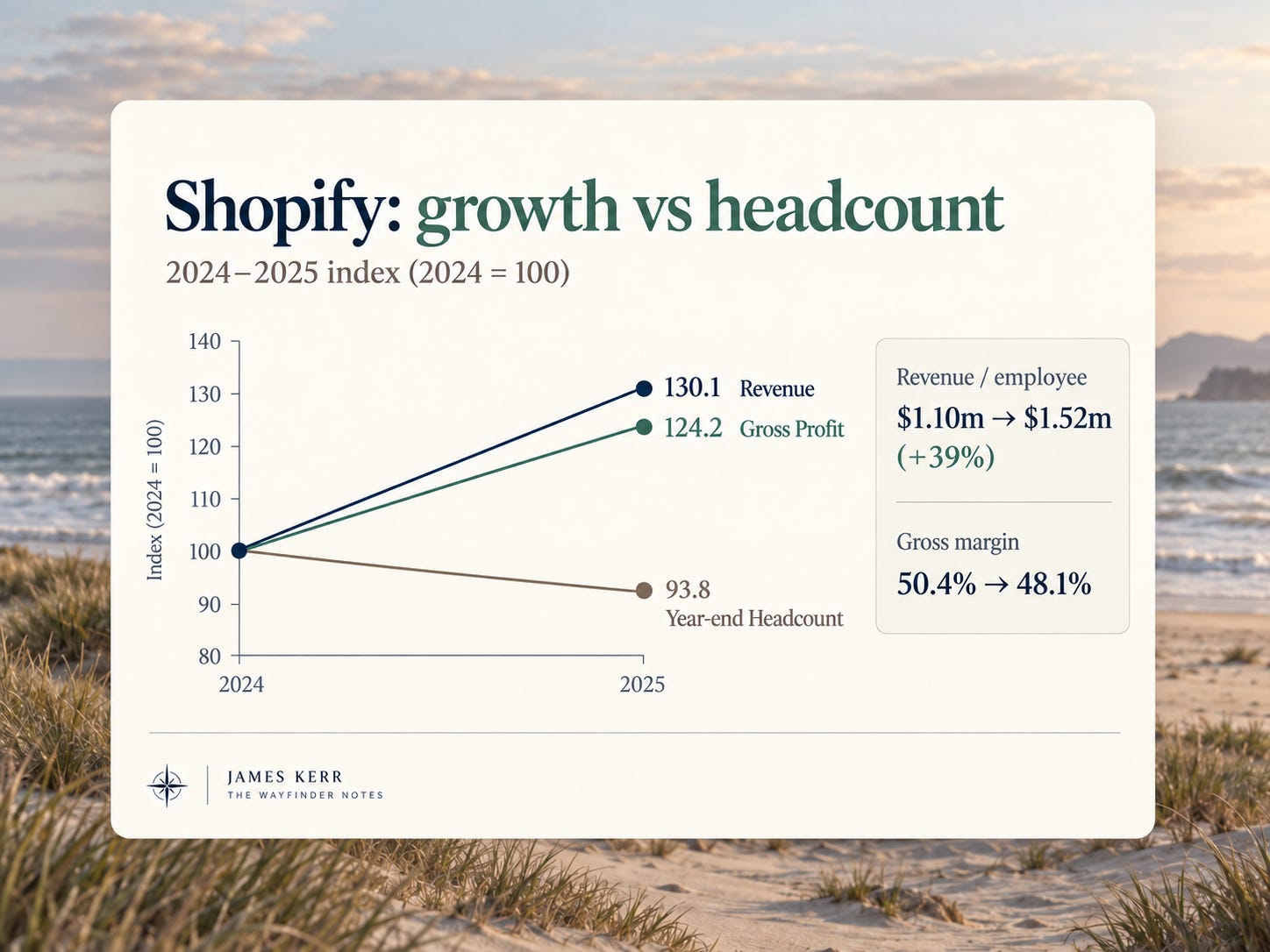
Shopify’s revenue growth relative to headcount speaks for itself. (To clarify: I’m not implying this growth is all due to this rule, but I’m sure it’s a contributor)
So what?
Whether you’re a solopreneur or an operator in an enterprise: Define outcomes and stick to them; be flexible on nearly everything else.
2. Build the Company Brain
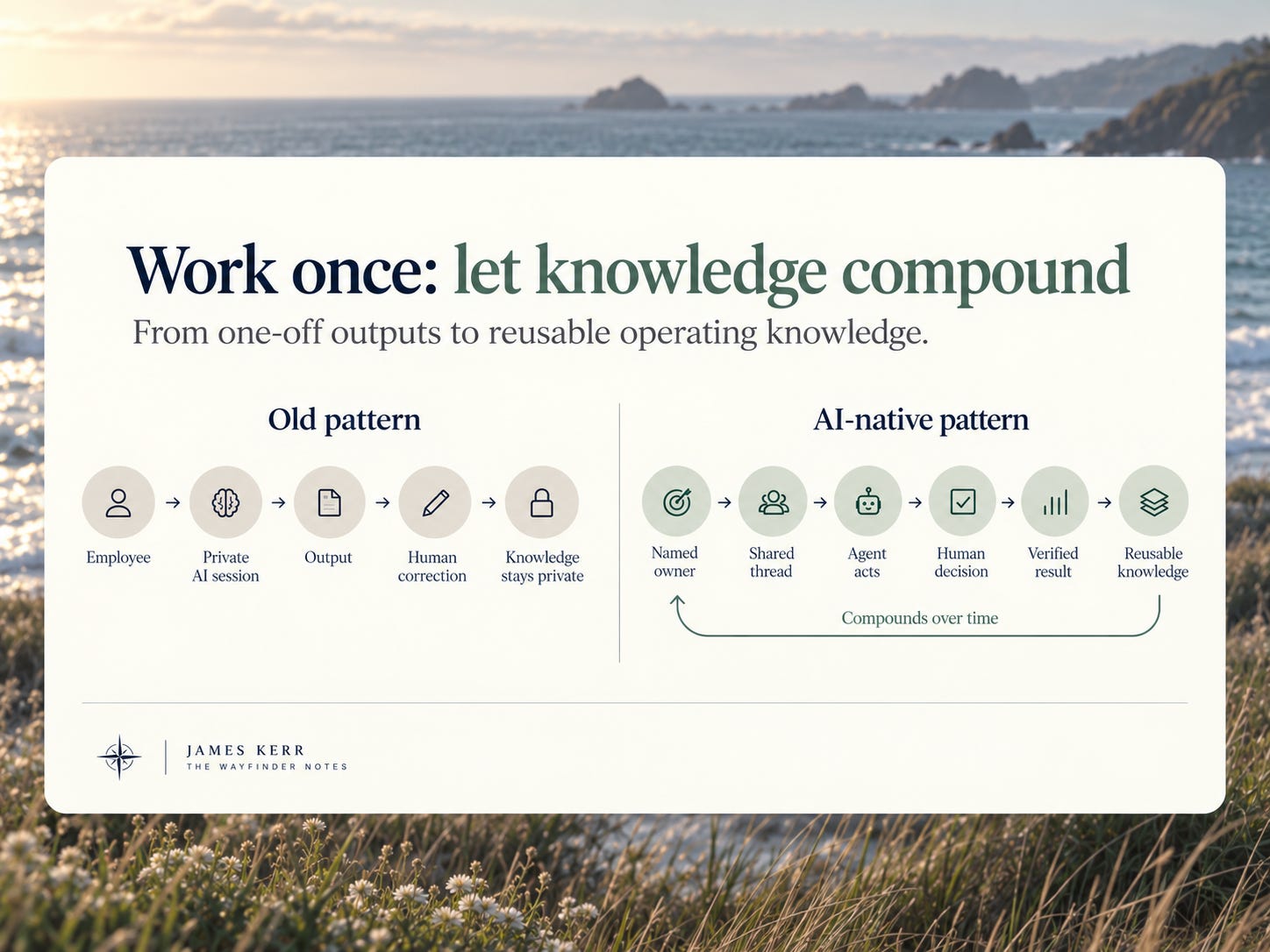
Imagine someone solves a tricky customer problem with AI. The answer used to just stay in their private chat.
Next week, someone else solves it again.
Brilliant. It’s company Groundhog Day.
Shopify’s answer to this was River, an internal AI helper in Slack that works in shared company chat channels.
Every chat with River is on public Slack channels, so it’s searchable and shared across the company. (Another strict forcing function from the Germany-born CEO)
All staff can see the work, add missing information, and learn from it. Useful patterns become instructions that are learned for the AI, whilst young engineers benefit from seeing how more experienced ones prompt their AI.
The strategy is foundational: treat all actions as data. Make sure your team and AI agents have a shared home for the information they need: customer facts, decisions, rules, and examples of good work. (Keeping sensitive material restricted)
If you automatically log the work and save the data, you can begin to use AI to help that knowledge compound.
So what?
What differentiates you from your competitors is your know-how. So find better ways to automatically log that know-how, share it within your teams and let that knowledge compound. If you’re a solopreneur / creator, the same applies to your partner network and who you cooperate with.
3. Process is to Humans as Acceptance is to AI
Many businesses create SOPs to reduce operational risk. For those with the good fortune of being unfamiliar: Standard Operating Procedures. Simply put: how-to guides that ensure people perform tasks in a specific way.
Now, with the increasing capability of AI, many teams and tasks across some domains, especially software, are finding that setting acceptance tests the AI can continuously work against until it’s done is more productive.
In its security work, Shopify says River follows changes through tests and reviews, then checks whether the original issue has been resolved. People remain responsible for approvals and important decisions.
In our previous example for customer success, the job would be finished when the customer has working access and knows the next step. A customer success agent under that manager would only be finished when it can tick off those acceptance criteria.
So what?
Give each AI agent process a clear definition of “finished,” a person who owns the results and a rule for when AI must stop and ask for help.
4. Look at Customer Behaviour; Stay Relevant
This is the biggest-picture chess move.
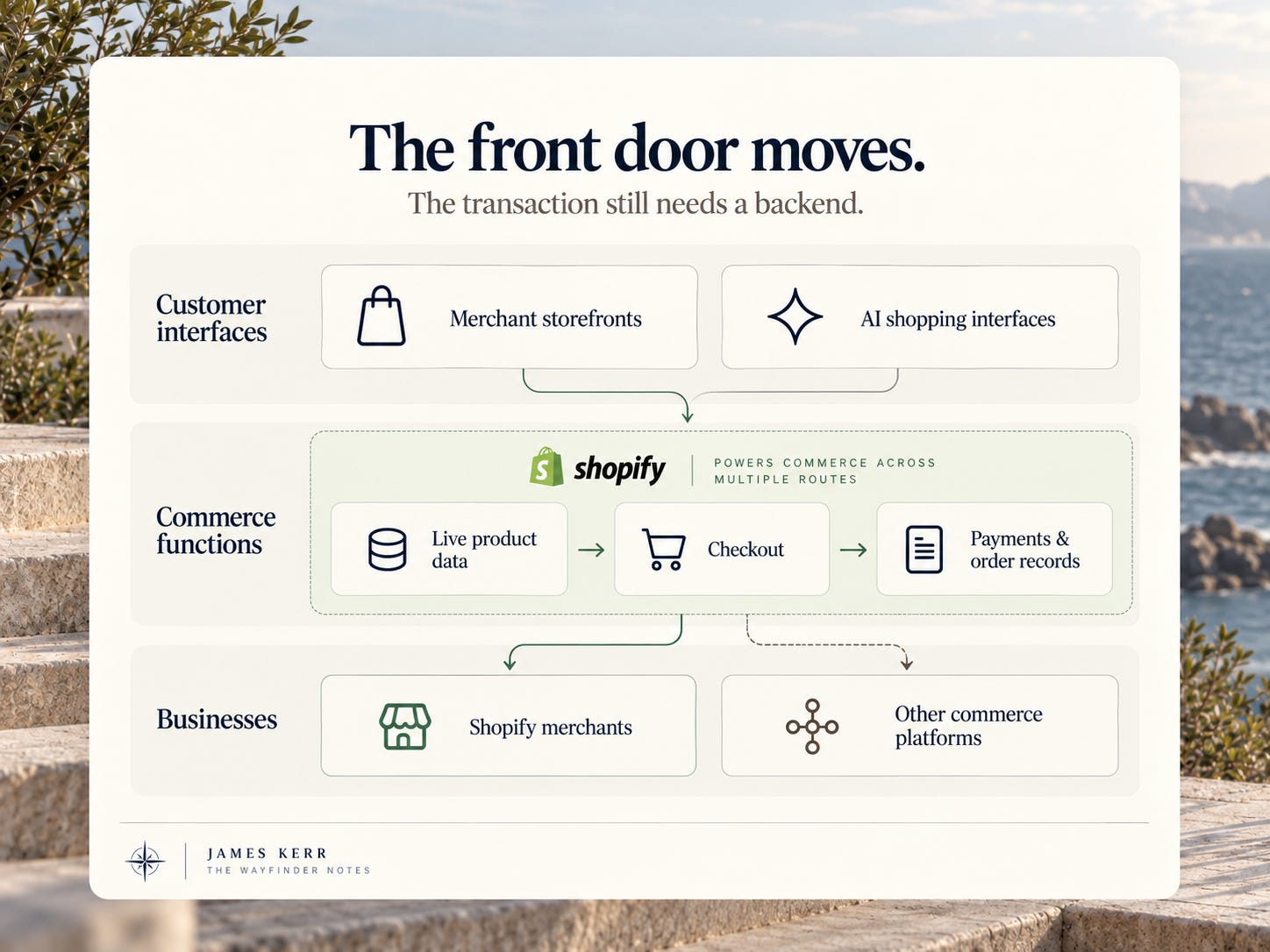
Suppose shoppers are increasingly asking an AI assistant like ChatGPT or Claude what to buy rather than browse a shop. That leaves the company supplying the shop software in a sticky position, right?
Well, Shopify's strategy was to be agile and focus on another part of the value chain. Start offering product information and checkout services that plug into the shopping experiences of AI tools. Crucially, it offers a plan for brands whose shops run on other software too.
This anti-lock-in approach enables Shopify to serve customers as much or as little as they need, as they know: customer convenience usually wins!
By building this trust with customers and an ecosystem strategy can also grow: shared rules connecting these systems also allow other commerce and payment providers.
So what?
For your business, ask: if AI made our most visible work easy to copy, what would customers still need us for? An agency might sell the work of running experiments and measuring results, rather than reports clients can now draft themselves. It could offer that service alongside the client’s existing team
For Further Exploration:
See you in the next one,
James
Great article - Tobi is one of my favorites to listen to speak in interviews. His interview on the David Senra podcast is another good one!