


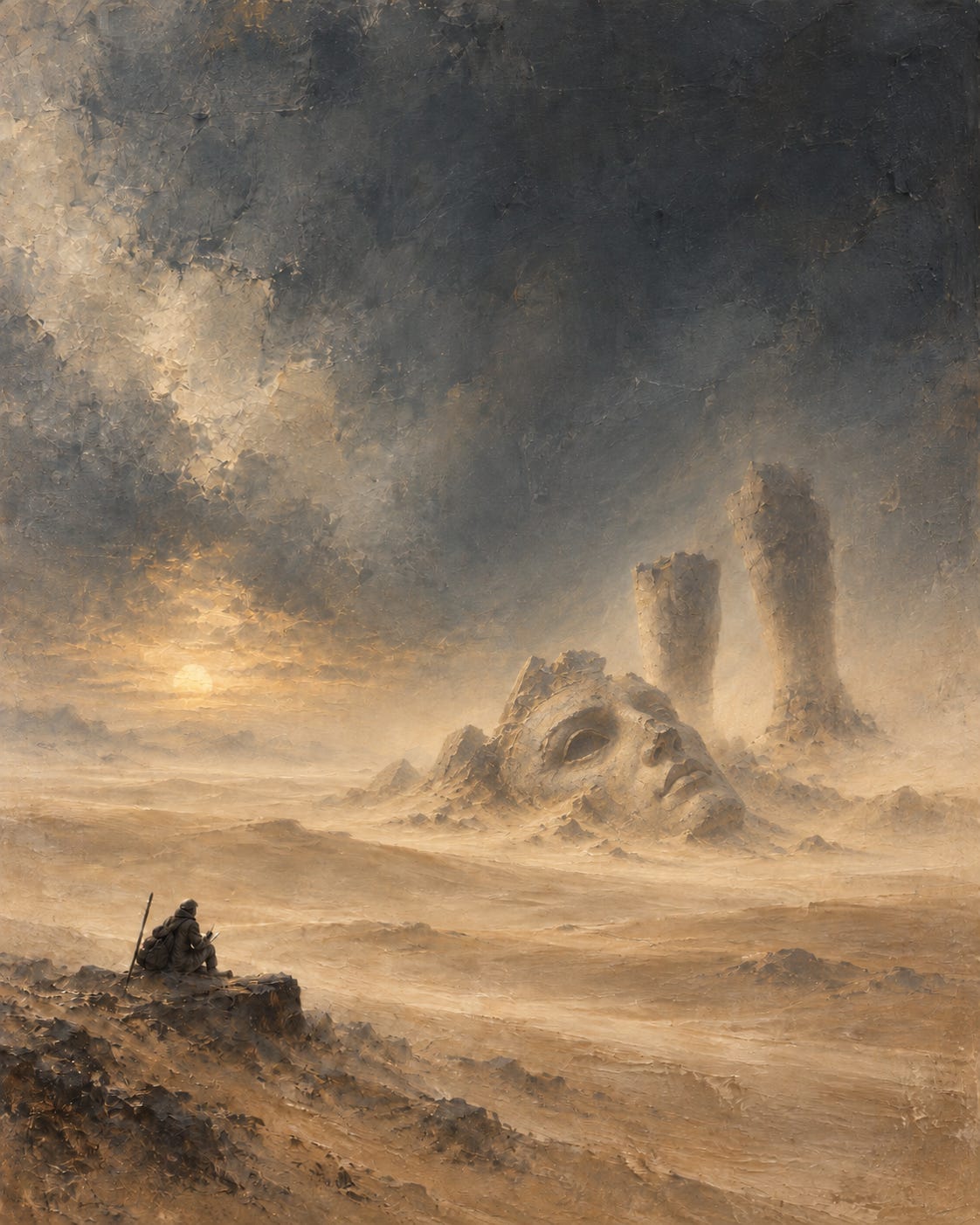
I met a traveller from an antique land
Who said: Two vast and trunkless legs of stone
Stand in the desert. Near them, on the sand,
Half sunk, a shattered visage lies, whose frown,
And wrinkled lip, and sneer of cold command,
Tell that its sculptor well those passions read
Which yet survive, stamped on these lifeless things,
The hand that mocked them and the heart that fed:
And on the pedestal these words appear:
“My name is Ozymandias, king of kings:
Look on my works, ye Mighty, and despair!”
Nothing beside remains. Round the decay
Of that colossal wreck, boundless and bare
The lone and level sands stretch far away.
– Ozymandias,
Percy Bysshe Shelley (1818)
Ye Mighty
Ozymandias was the Greek name for Ramesses II. Shelley never saw the statue; he wrote from travellers’ accounts of it lying broken in the sand.
Notice, though, that second line on the pedestal: “Look on my works, ye Mighty, and despair!”
Ozymandias wasn’t talking to his people. He was talking to other kings, and the statue, the pedestal, and all of it were built to make his rivals feel small by a man who was about as far from his own people as it’s possible to be.
The white towers of consulting were my Mighty.

I launched into corporate consulting in London because I wanted to know what life was like in the white towers.
I’d look at the people at the top of those buildings, those partners whose names meant something in any room. I saw the respect that they had from clients and peers alike. I thought I wanted that: the feeling of having done something that would be remembered.
Underneath it all, I wanted to help people. But I was also chasing validation: that wonderful feeling when someone is happy or grateful because of something you’ve done, said, or given.
I was the strategy consultant who could programme, so after ChatGPT came out, it wasn’t long before I was advising clients on AI. Then, over the next year, the tools started to get quite good.
Now, it’s hard to overstate just how much blood, sweat, and tears I’d put into learning all the shortcuts in Microsoft and years of PowerPoint alignment, alongside everything I picked up from programming. Yet here was AI, ready to threaten the foundation of my personal moat.
At that moment, I asked myself, “Am I really doing what I want?”
I knew I wanted to build and help. But I wanted to be closer to the outputs. I realised I was too far from the effect. Even just the decision-making inside a big corporation could take so long that you’d never see what your work did. All that work for nothing I could tangibly point to. Yet every month, AI capabilities made it more possible to build.
So I left consulting to build.
Ozymandias’s Curse

When I left and started ‘Ascend’ (The tech startup before CURN), I nearly did it again. We built a tool that let those who know how to use AI record themselves on screen and share it as methods, like Loom or Scribe, but with prompts, responses, and outputs recorded clearly for immediate context. We could sell it cheaper than them, too, since we didn’t have the technical overhead.
We took it to our old clients. The people who signed off were sold, but the people who had to use it every day were too unsure of AI, classified themselves as ‘dinosaurs.’ The problem was the people who said yes weren’t the people who had to use it. Our assumption was that there were always one or two people who knew how to use AI, with this product they could record themselves to show the rest. But we didn’t factor in that they wanted to keep their advantage. Why would they share their hard work with their coopetition?
Meanwhile our learners didn’t feel confident enough to use it. In getting them to use it, we became AI adoption specialists, using our product as an enabling force to help.
We all have our own Mighty. Those we want to impress: maybe investors and old bosses, whoever.
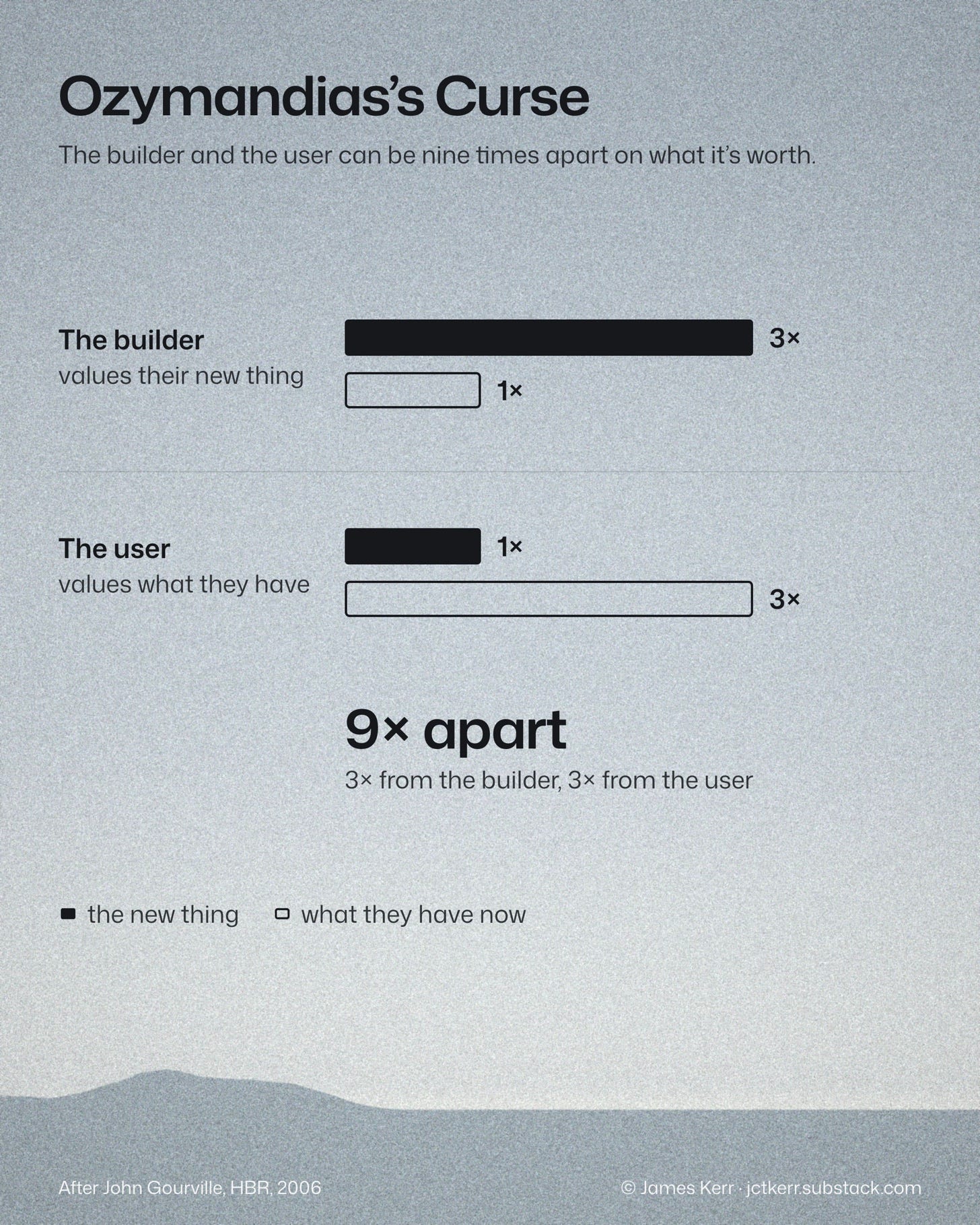
Unfortunately, we often overvalue what we have by three times, and people building something new overvalue that by about the same amount. It can be in the opposite direction. So the quote that's being hurled around startups, bastardising John Gourville’s Harvard Business School report, says that the builder and the user could be 9x apart on what’s worth building.
This is what I’d call here the Ozymandias Curse: the further you are from people who have to live with your works, the more you believe in them.
More Than Ever

If you’re reading this, you’ve likely felt the pull to build, and it’s never been easier to act on.
It’s crazy that one person with no team and just a few evenings now can ship what used to require a fully funded company and a year. That is more opportunity for more people than there has ever been, and I do not say that lightly.
BUT, and this is a big but.
It’s the same opportunity for everybody. When anyone can build almost anything, almost anything can be copied, and you can’t tell with confidence where exactly that value will settle. At least I can’t, and the AI labs certainly can’t.
Predictions about the times ahead are fun; I will continue to guess, but we must assume we’re headed towards a world where the only true moats are those formed by platforms and regulation.
This is a world where friction is gone, data lock-in is a thing of the past, and agents can essentially build and do anything for their users.
But there is one thing that is entirely yours: choose who you build for and how close you get to them.
Opportunity will still lie in understanding information not in the training data — the messy human stuff, the frontier of our knowledge — and the good news? There’s a lot of frontier to go around!
Nothing Beside Remains

Okay, be close to the customer. That’s the conclusion, right? Not quite.
In 2022, Jasper was at the height of its game, a tool that helped marketers write with GPT-3. It had raised $125 million at a $1.5 billion valuation, and then, six weeks later, ChatGPT came out and gave away its core for free. Unfortunately, within the year, Jasper had to cut staff, and its co-founder stepped down as chief executive. Now, this story is becoming so common that ‘ChatGPT/ Claude DESTROYED all xyz startups’ clickbait titles are now even considered cliché.
Then it was startups; but now? Entire professions.
This month at Rails World, ‘DHH’, the man who created Ruby on Rails, told a room of developers, “It’s pencils down, people.” Writing code by hand, he said, no longer makes economic sense for most programmers. He said he’d retired from being a professional programmer. He calls himself a “maker” now.
One report even called this “the most confusing funeral I’ve ever experienced.”
Unfortunately, many mathematicians think they’re in the same boat. Earlier this month, OpenAI announced an AI-generated solution to the Navier-Stokes problem, one of the seven problems for which the Clay Institute offered a $1 million prize in 2000. Many have since reported an existential crisis in the field.
When the thing you’ve spent your life getting good at can be done by a machine, the question stops being about work, and it becomes, “What do I do?” Closely followed by: “What is my purpose?” (and a good Douglas Adams book)
The Sculptor
Go back to the poem: The King’s works are gone, and his name survives only as a warning. There is one thing still doing exactly what it was made to do.
“Tell that its sculptor well those passions read
Which yet survive, stamped on these lifeless things”
The sculptor stood close enough to a man to catch the frown, the wrinkled lip, the sneer of cold command. Three thousand years later, the reading is still there in a broken stone. We do not know his name. He never carved it anywhere close to the work he did. It was well done.
We can’t promise anything will now survive obsolescence. Entire business empires built over a lifetime may fade.
But as DHH says, he’s stopped programming and started ‘making.’ Mathematicians will still love the new problems that arise that can’t be brute-forced. You and I still love reading and writing on Substack to express and share our thoughts.
The actual conclusion from all of this?
Yes, achieve the outcome. Do the job well as the sculptor did.
But also? More than ever, enjoy the process.
Start With What You Have

It does lead me to our final thought I’ve been pensively agitating on recently:
How do you choose what to build when nobody can tell you what will last?
Part of enjoying the process, after all, is at least thinking you’re doing something worthwhile.
I think I found the answer in the work of someone I studied during my master’s.
Saras Sarasvathy, a professor at University of Virginia Darden, asked those who should know best. She gave 27 expert founders, each of whom had taken a company public, the same venture problem and had them think out loud. She wanted to know what made them successful in their ventures during such uncertain times.
What she found became a theory she called effectuation.
The thing in common was that when the future couldn’t be predicted, most of them didn’t even try. They just worked on what they could control.
Three of her principles in plain words:
Start with what you have: who you are, what you know, and who you know.
Decide up front what you can afford to lose: Expected returns are a guess, but your own limits aren’t: time, money, etc.
Build with the people who commit, not the ones who applaud: Her experts let the first people to sign up shape what got made.
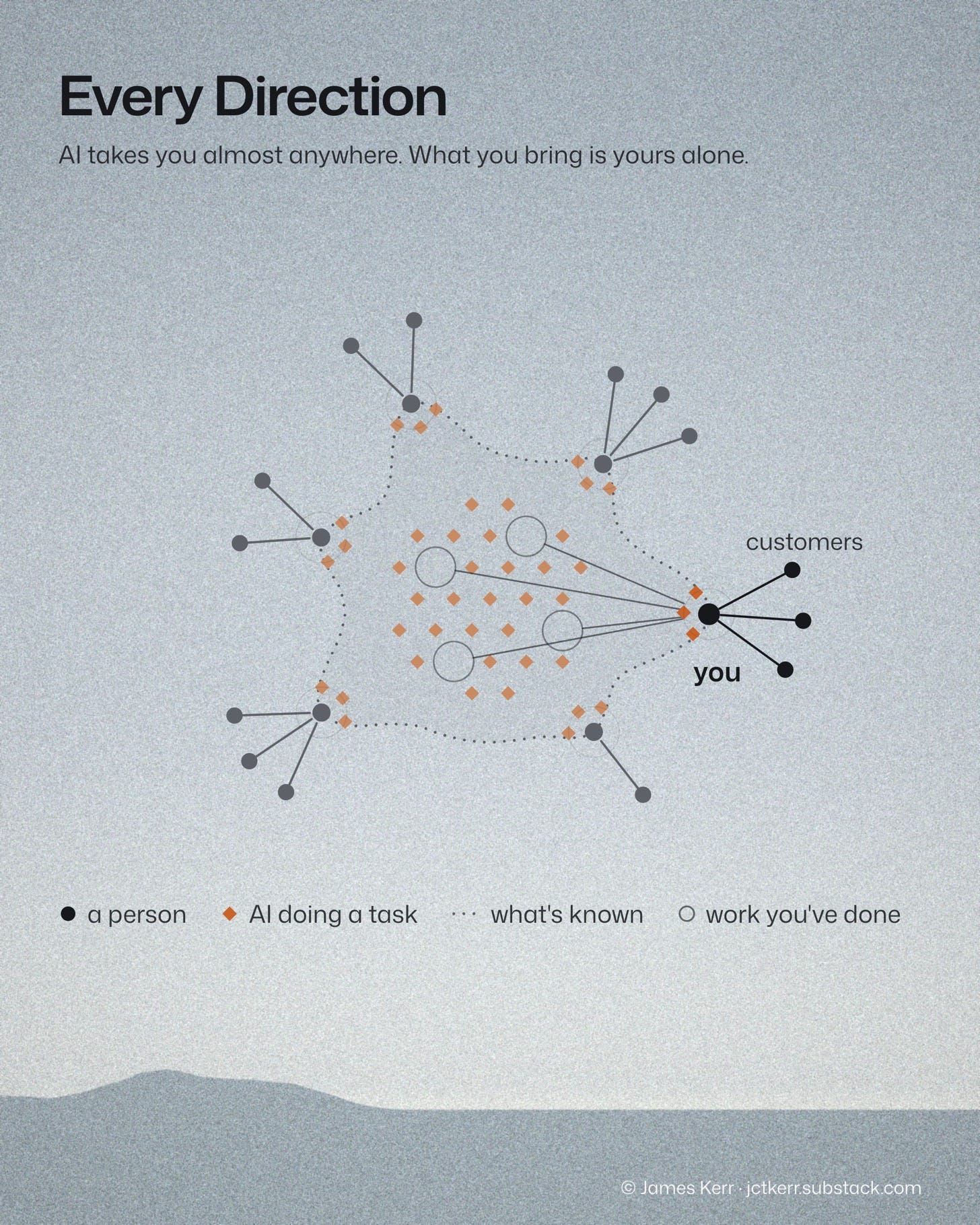
Now, what does AI change? Slowly, we’re starting to build this centre, this floor around us, of common knowledge that is expanding ever outward in every direction. I may be a business consultant, but if I wanted to, I could ask ChatGPT Pro tomorrow for a great analysis that adds my perspective to solve a problem, either through luck or judgement (In fact, this is what happened with the 23-year-old who solved an Erdős problem).
If you focus, you can now reach the edge in weeks rather than years. Let demand choose the direction. Go where someone is already asking for help, or in the direction that fits you, not someone else’s expectations of you.
What you bring when you get there is the breadth of what you know, the work you’ve done, the experiences you’ve lived, the problems you’ve lived with, and the people you know. Nobody else has that mix. Build from it, and whatever you make adds up to you.
On the bright side, AI could be the greatest humbling ever to happen to man: No more colossus in the sand.
James I loved reading this! I’ve been thinking a lot about mythology, and the universal lessons that hold true through time with the power of story, and I love how you tied that in here.
Also, how you were on a journey to sell one thing, but became someone else (AI adoption expert) along the path and how that actually became the next thing. Such an interesting example of your enjoy the process point - and of how the process can shape us.
Powerful message at the end to go in the direction that fits you, not someone else’s expectations of you.
Thank you for sharing!!
James, I really enjoyed this, especially your honesty about Ascend. Winning approval from the people buying something can feel like validation, until the people meant to use it walk straight past. That gives real weight to your point about staying close to those we build for. And the sculptor is a lovely reading of the poem. There’s something reassuring in the idea that work can be worth doing well even when we can’t know how long it will last.