


Ok, so the question isn’t any longer whether one person (or a few) can build something that once took a company. That’s already been answered…
This week, I saw the latest episode of this one of the founders of Builder.io release a whole load of useful work into the open, including essentially Loom but for free. The incentive for builder.io as far as I can tell is using this as a ‘lead magnet’ for brand awareness and a goodwill driver, as well as his stated belief that software should be free.
If you haven’t seen it I recommend at least watching:
At the same time, Kimi K3 arrived as another open model pressing against the frontier. The individual releases will be overtaken soon enough. The interesting thing is the direction we’re going in: capability keeps escaping the institutions that used to fund it.
Seven months ago I wrote about this the Era of the Experimenter. That piece was about permission. AI had made trying so cheap that normal people could build products which, a few years earlier, would have needed funding and a team.
I think the next phase is about selection.
When almost anyone can experiment, who gets chosen?
After permission comes selection
For most of the industrial age, scale required separation. The designer designed, the engineer built, the manager coordinated and the marketer distributed. The company existed partly to gather those fragments into one machine.
The internet loosened the arrangement. A YouTuber could own an audience that once required a television network. A writer could reach readers without a newspaper. But the work was still a production. This talks to one of the forms of leverage I talked about in Icarus Intelligence Problem. The successful creator who wasn’t afraid to be cringe quietly became a small media company, with cameras, editors, researchers, sponsors and a publishing schedule (and now many are very large ones).
Now in the grand cycle of bundling and unbundling, AI is unbundling production itself.
A capable person can move from idea to research, design, engineering, customer support and distribution without becoming world-class at every step. They need enough understanding to direct the system, enough taste to know when it is wrong, and enough care to keep improving the result.
That person is not quite a founder, freelancer or creator. I think we need an older word for a new kind of work.
An artisan. (Also sounds better)
The return of the whole maker
The first artisans were whole makers. The person who chose the material also shaped it, sold it and stood behind it. Industrialisation broke that unity because division of labour was economically overwhelming. The Arts and Crafts movement could defend the dignity of craft, but handmade objects could not beat the factory on cost or reach.
The new artisan does not reject the machine.
Instead, they bring a workshop of them.
Their judgement remains visible in the output, but their methods are captured in software, agents, workflows and media. Every improvement to the method can be applied to the next piece of work. Every useful thing they publish can find another customer. Craft, which used to resist scale, starts to compound.
That is the important distinction. A freelancer sells their portfolio. A creator sells attention. A software company sells a product that works without its maker. The artisan can combine all three: a recognisable body of work, a direct relationship with a market, and systems that let one person’s standards travel much further than their time.
The range advantage
There is another requirement: the artisan will have to master more, not less.
In Range, David Epstein argues that complex, unpredictable fields often reward people who sample widely and transfer ideas across domains.
The point is not that specialists are obsolete. It is that real problems ignore the borders between specialisms.
AI intensifies that effect. When a model can supply a competent first pass in almost any discipline, knowing where to look becomes cheaper. Knowing how the pieces affect one another becomes more valuable.
But this doesn’t lower the bar for mastery. Instead, it raises the number of things one person must understand. The artisan needs one craft deep enough to set a standard, then real competence across the crafts that touch it.
A designer may need engineering, economics and distribution. An engineer may need product taste, customer research and storytelling. A consultant may need to turn judgement into software, media and a repeatable method.
In the industrial firm, mastery was divided among roles. This was a fine setting of the glass for the information firm, so we kept it. However, in the artisan firm (can be just the one, or scaled) more of it has to be recombined inside one person.
The advantage is not generalism as shallow familiarity with everything. It is stacked mastery: a range of skills developed far enough that each improves the others.
The old company hired a department for every problem and managers to coordinate them. The new artisan carries more of the map in one mind, then uses AI and specialists to extend their reach.
(Between the initial writing of this piece and the publishing, I spotted Boris Cherny, creator of Claude Code, stating very similar combinatory role abstractions going on within Anthropic. Great example of just how much range is already becoming necessary in AI-native organisations.)
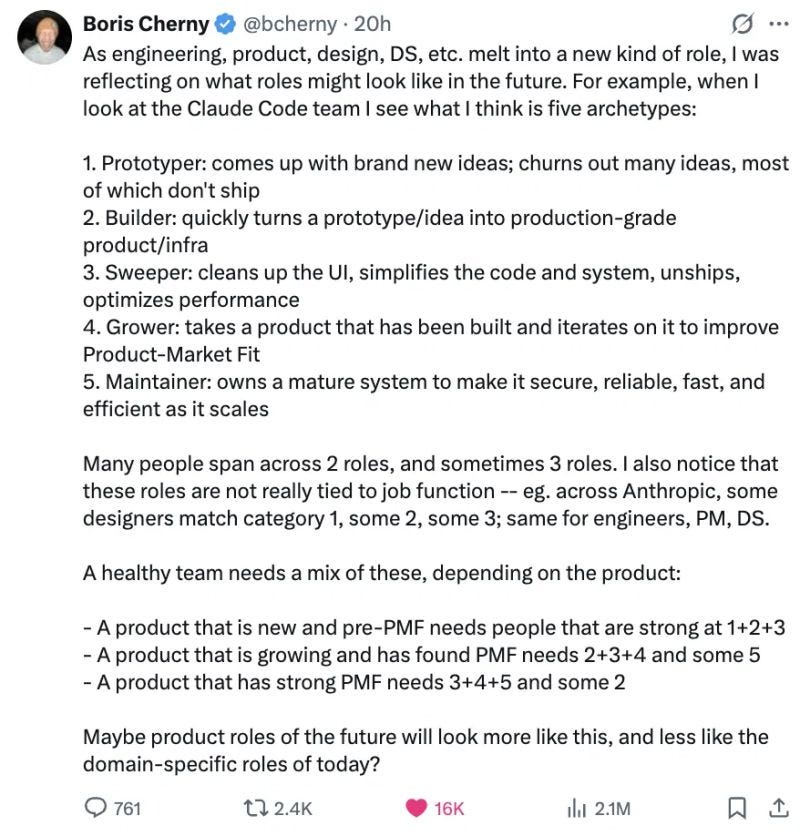
AI gives everyone fragments of expertise. Range lets the artisan make the fragments cohere.
Why does this win? Coordination. One of the most powerful strategic forces.
Short-term pain, long-term gain
A venture-backed company must eventually return capital at venture scale. Funding buys speed, talent and distribution, but it also creates a particular hunger. The company needs a market large enough to justify the money, margins high enough to support the organisation, and growth fast enough to keep the next round plausible.
An artisan has a different hurdle. They do not need to own the category. They need enough customers.
That lets them serve markets a funded company cannot justify entering, charge less because the coordination layer is thinner, and stay with problems that look too small on a venture spreadsheet. If the underlying software and intelligence are open, the artisan can rent the same capability without carrying the institution that created it.
It would be too neat to say they can always undercut the company. Compute, compliance, insurance, support and trust still cost money. Large firms can subsidise a product, bundle distribution and wait out a smaller rival. In the short run, distribution is probably the artisan’s greatest weakness.
But in the long run,.. it can become their advantage.
The artisan who can explain the work, teach the method and earn a direct audience does not have to buy distribution forever. Each public artefact makes the next sale a little easier. Each customer conversation sharpens the craft. Product and reputation improve together.
So what? How to win
So, how does the artisan actually win?
Not by producing the most. AI will make volume almost meaningless. Nor by mastering every new tool. The tools will change too quickly for that advantage to last.
They win by becoming difficult to substitute.
First, develop a standard. Have a point of view about what good looks like that goes beyond whatever the model produces by default. Taste is not decoration here. It is the ability to notice what is missing, make decisions under uncertainty and reject work that is technically competent but somehow wrong.
Then, turn that standard into a system. Capture how you research, decide, build, review and improve. The aim is not to automate yourself out of the work. It is to stop solving the same problem from zero. Your agents, workflows and libraries should become a workshop shaped around your judgement. At this stage if you’re feeling a bit ambitious, also tag in creating a product around your judgement, expertise and system.
Next, publish the evidence. Show the work, explain the decisions and the method or your thinking. In a market flooded with plausible claims and instant products, a visible body of work becomes proof that you can be trusted. Distribution is no longer something added after the craft. It is how the market learns that the craft exists.
Finally, own the relationship. Platforms will change, models will commoditise and products will be copied. A direct connection with customers, readers and collaborators lets the artisan carry demand from one form of work into another.
That creates the compounding loop:
The craft improves the product. The product produces evidence. The evidence earns attention. The attention brings better problems. The better problems deepen the craft.
This is more durable than a personal brand built on attention alone. The point is not to become the loudest personality in the market. It is to become known for a particular standard and to build the machinery that allows that standard to scale.
When capability is abundant, people will not struggle to find someone who can make something.
They will struggle to decide whose version deserves their trust.
That is where the artisan who consistently shows up, who masters their own unique range of useful skills and who hones their taste and systems to take advantage of the AI as a fifth form of leverage will win.
The workshops ahead
This doesn’t mean the end of companies. Capital still matters where the work requires factories, regulation, vast infrastructure or thousands of coordinated people. Even in software, many artisans will form cooperative networks because some problems on the jagged edge genuinely benefit from many minds.
The change is in the default unit.
For a long time, craft and scale pulled in opposite directions. Scale standardised the maker out of the product; craft stayed personal and therefore small. AI opens a third possibility: the person’s way of doing things can scale without the person disappearing.
The Era of the Experimenter is about starting and pushing in a now near permissionless world.
The Age of the Artisan is going to be about being the one worth choosing once everybody can start.
We have spent the past few years asking whether one person can move like a large company. The more interesting question is whether one person can carry a craft, a library, a market and a school of thought with them in one package, to the world.
And, if they can, what will you build your workshop around?
Thank you for reading!
The phrase, "The Era of the Experimenter is about starting... The Age of the Artisan is about being the one worth choosing," really captures what I'm experiencing as a software engineer in my day to day life. AI has made execution cheap so the barrier to building has almost disappeared. However, this has also changed where true value comes from.
AI can assist with tasks, but it can't replace good product judgment, deep understanding of users. Those who truly stand out won’t just be those who release products quickly instead, they’ll be the ones who genuinely understand market needs and know what to create and how to design it effectively.
The moment “artisan” becomes a marketing category, it starts losing what made it valuable.