



Hey ,
Welcome to the second edition.
Every Thursday, we break down one company’s AI playbook: their strategy, how they’ve been successful (or not) and what you can take away for your own work.
Last week was Shopify. This week: Stripe.
The fintech darling of the famously precocious Collison Brothers:

TL;DR: Q&A-style
How do you prepare your organisation or team for AI?
Lay the foundations: think like a librarian: Stripe’s coding agents hit the ground running precisely because engineering had already built guidelines, docs, tests long before agents came around
Who should be responsible for AI at work?
Put AI responsibility on the people who do the work, not just specialists: Each of Kai’s (Stripe’s AI) 1000+ skills is owned by the team that does that work, and Stripe’s marketing and sales teams use it more widely than engineers
How do you keep AI’s work in check?
Put AI between fixed step and sign it off yourself: at Stripe fix checks. Test every change, and an engineer reviews each and every one
Has all of Stripe’s AI Strategy worked?
Not yet: Internally, it’s been very successful, but externally it’s a company that’s a first mover, not afraid to take risks and some haven’t paid off
Stripe
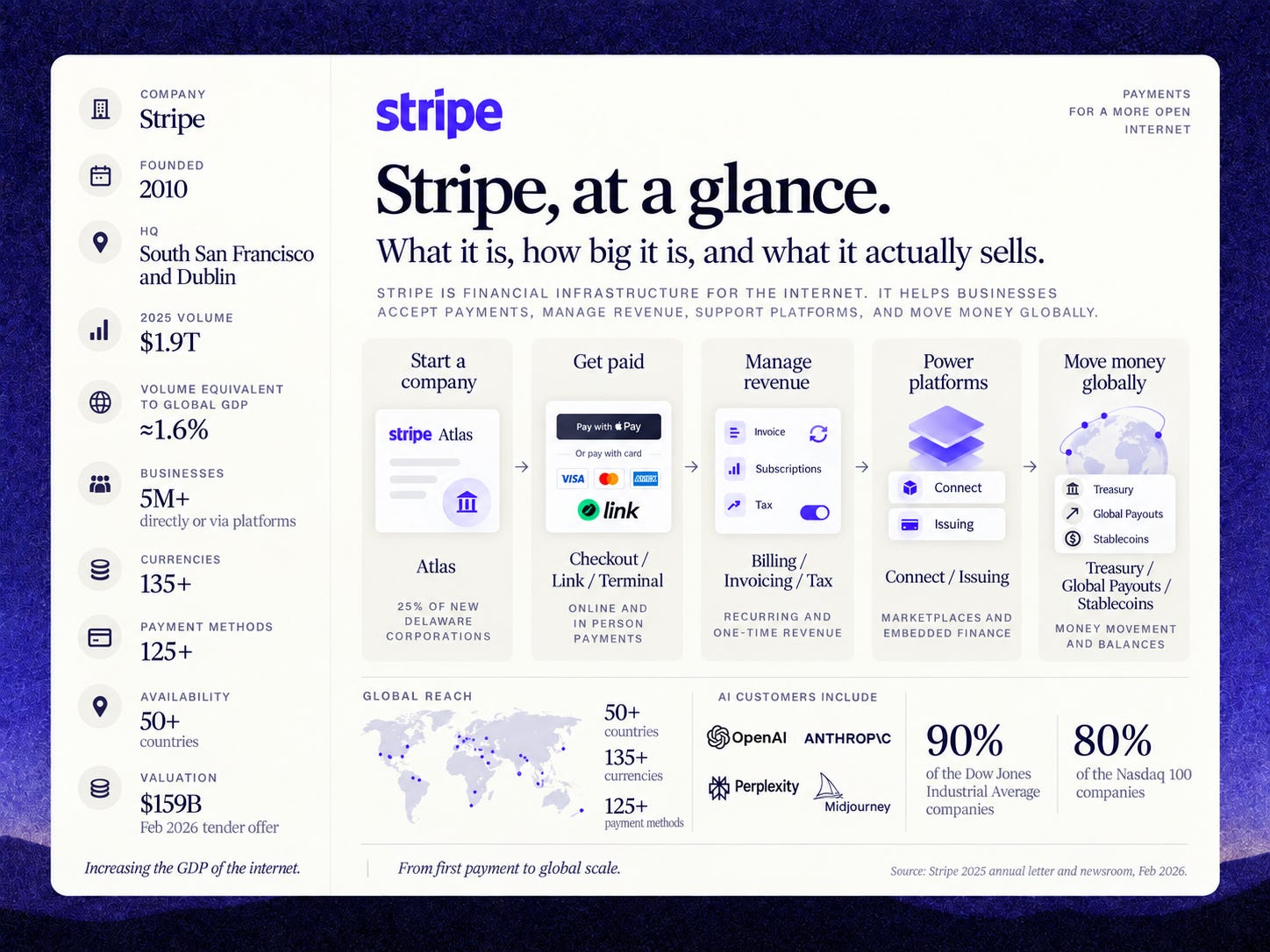
Stripe powers more than 5 million businesses, directly or through platforms. Last year $1.9 trillion went through it, about 1.6% of the world’s GDP by Stripe’s own estimate.
It’s ridiculous to think that Stripe powers over 5 million businesses directly through platforms. Last year, over $1.9 trillion went through its systems. That’s about 1.6% of the world’s GDP. Crazy.
Stripe’s AI story is a tale of two halves, fitting for the Collison duo. Inside the company, they’ve ensured the latest and greatest tools spread like wildfire. Their strategy outside is to take the big bet that AI agents will soon handle most internet transactions, but it hasn’t always been plain sailing.
1. Lay the Foundations
Stripe’s coding agents hit the ground running because they run on things the company had built for its engineers first anyway
Someone in Stripe definitely has a sense of humour, as they call their coding agents “Minions.” These minions run on the same disposable workplaces (sandboxes) that engineers use, each ready in about 10 seconds and populated with real customer data, live systems, and the open internet.
This is now a mainstay of most AI engineering, as it allows agents to work without affecting the real systems or other people, but Stripe was among the first to do this.
This developed from a culture of equal parts engineering and sweating the small details: the extra documentation and context.
The agents also get the same tests (more than three million of them) and read the same written guidance that Stripe’s engineers use every day with their AI tools.
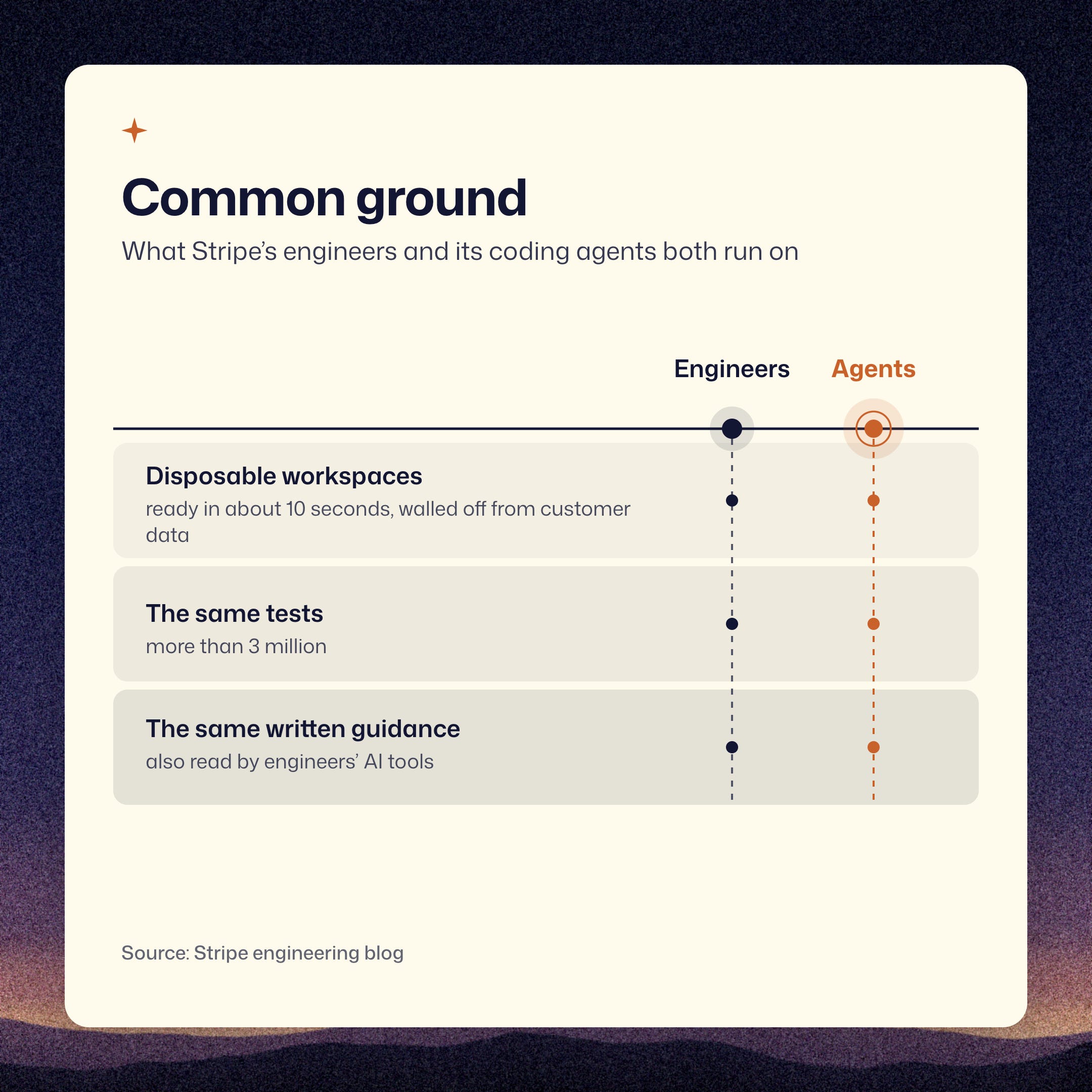
“What’s good for humans is good for agents,” as Stripe’s engineers put it.
So what?
The groundwork is the written-down version of how you work:
the steps
an example of good work
the checks you run before anything goes out
AI will not save you if you’re bad with documentation. When it comes to the foundations of using AI in business, the same principles apply to humans and agents.
2. Give AI to the people who know the work
When AI coding tools took off, Stripe’s engineers got the benefit first. By Stripe’s own account, sales reps, finance analysts, and technical account managers felt left behind.
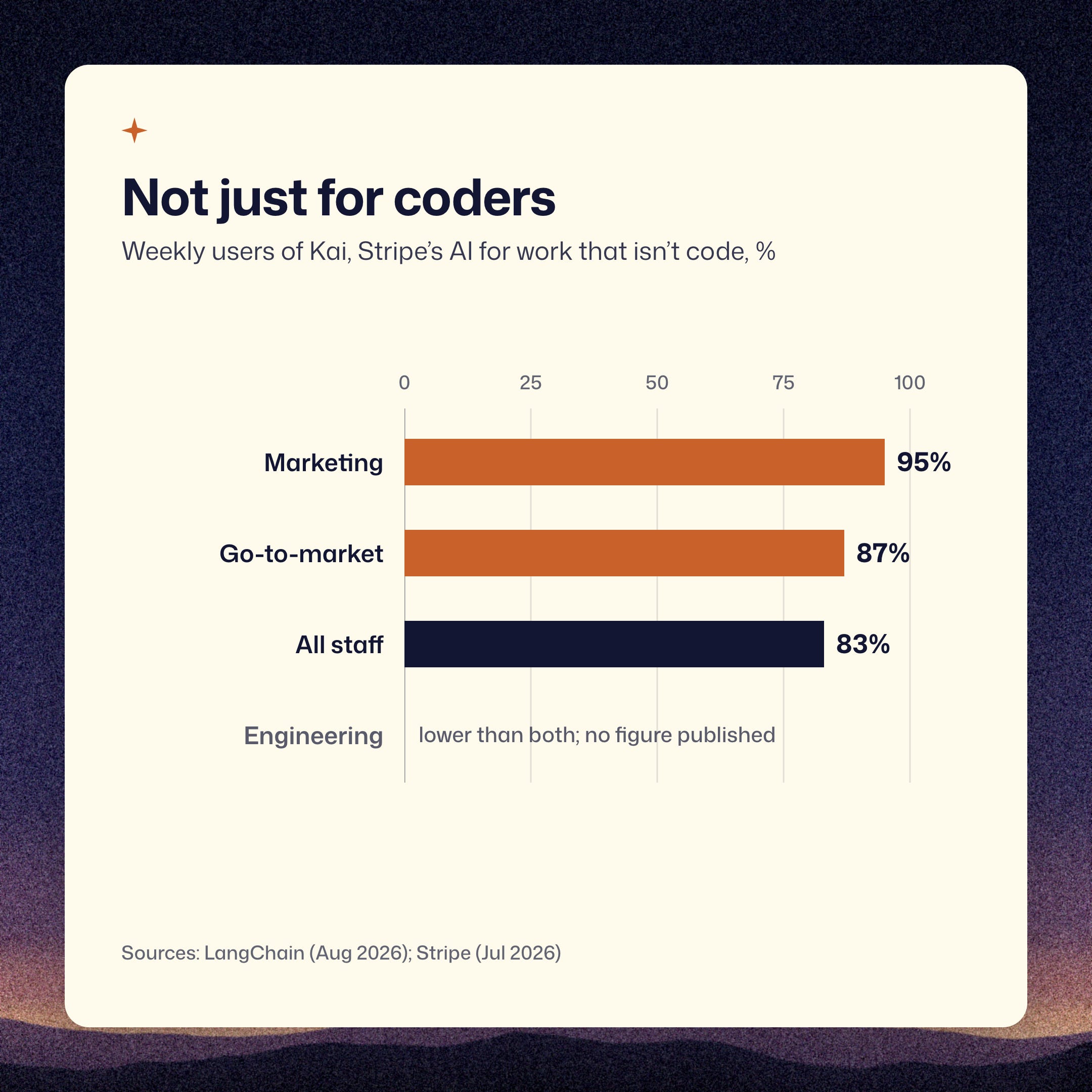
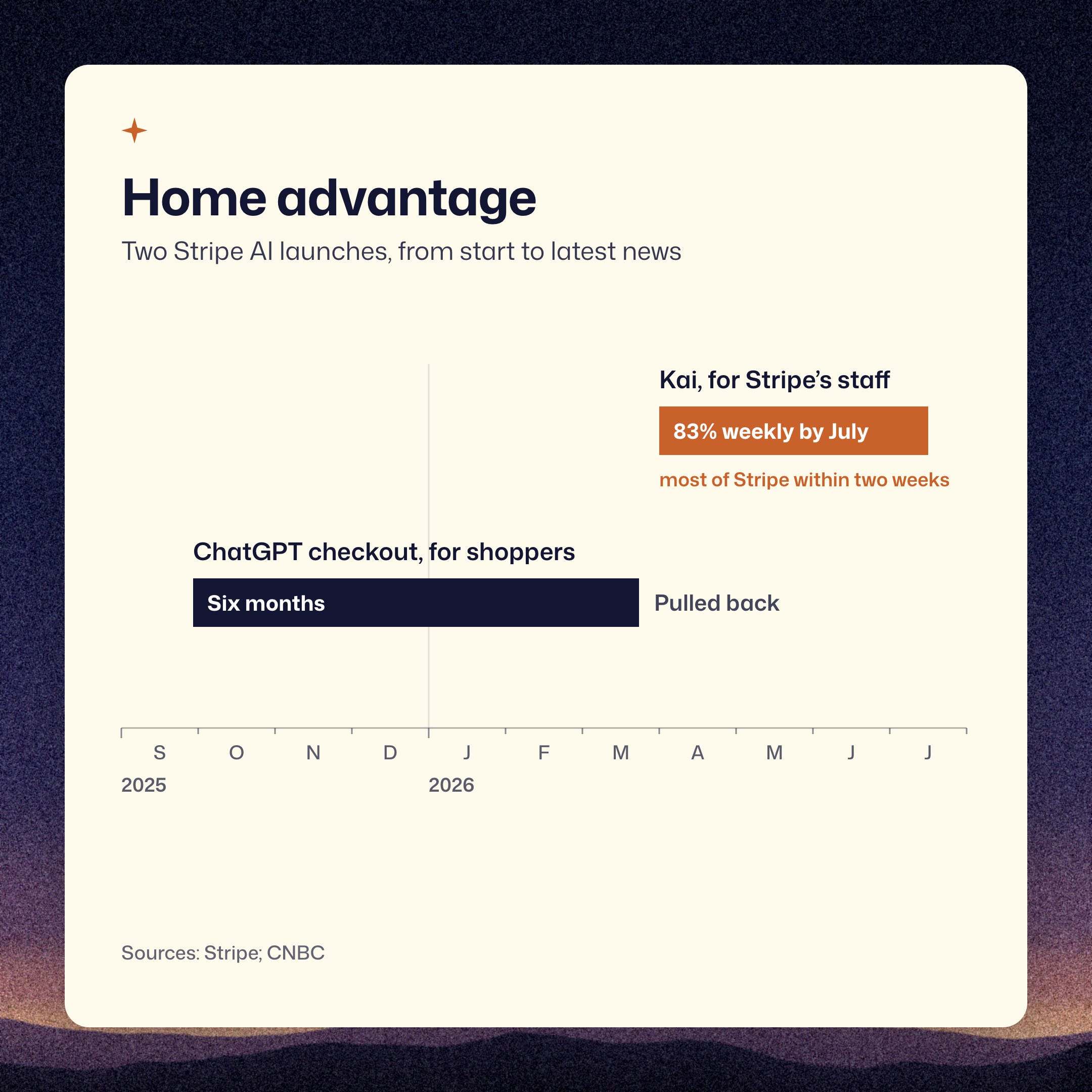
In April, Stripe gave them Kai, an AI for work that isn’t code, already loaded with how Stripe runs. Within two weeks, most of the company was using it. By July, 83% of staff used it every week.
A LangChain case study a few days later put marketing at 95% and go-to-market teams at 87%, BOTH ahead of engineering.
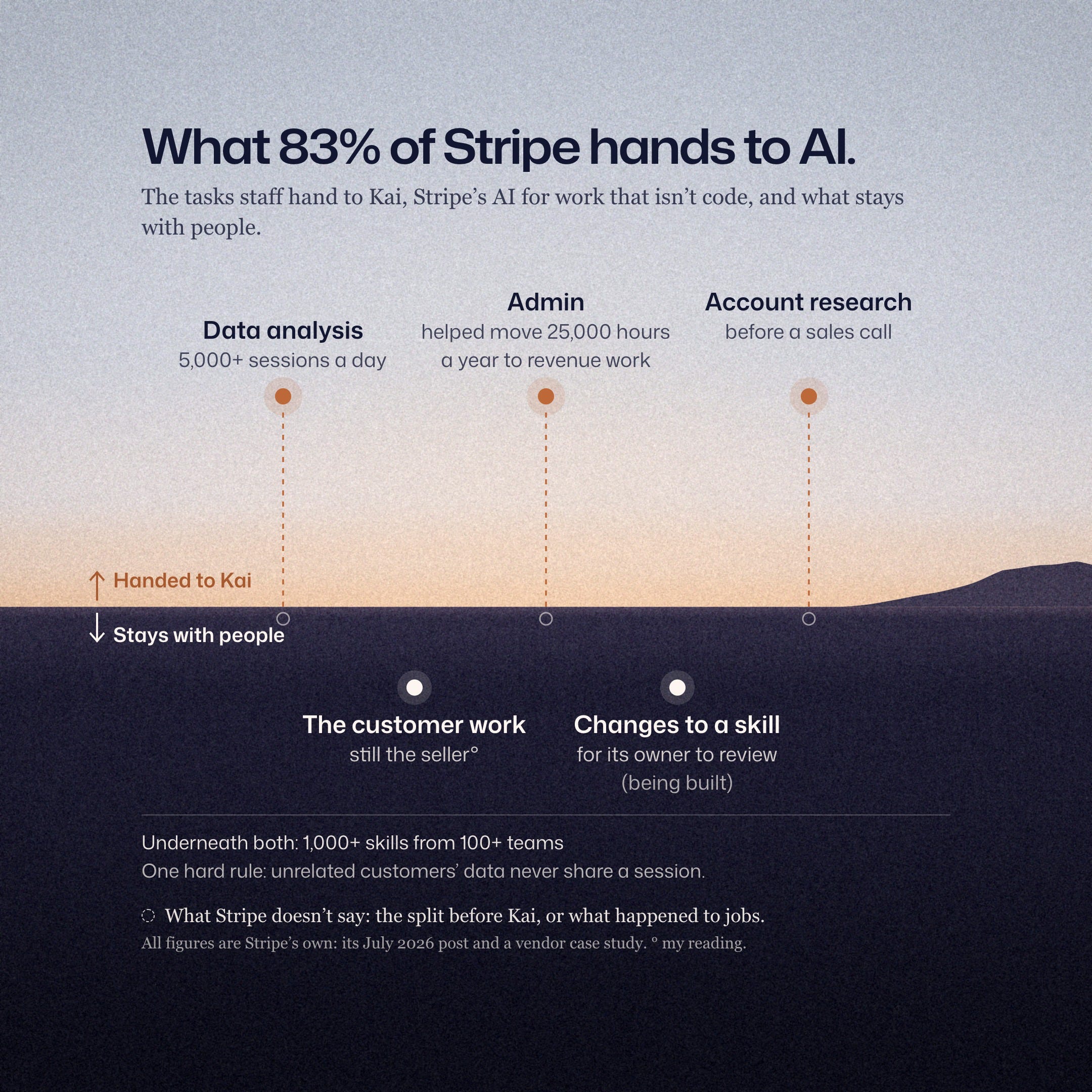
Much of what they hand over is unglamorous. For example:
More than 5,000 data analyst sessions a day
Research on an account before a sales call
Recurring digests
Stripe says Kai has helped move 25,000 hours per year from admin work to revenue-generating work.
It did start a bit chaotically, though. Before Kai, anyone could build their own agent with a no-code tool, and so employees built a lot: 4,000, in fact. Each also had prompts of varying quality, but they quickly became extremely hard to maintain.
Then they built another internal tool called Harbour, where you describe a prototype and the AI builds it. Since May, the uptake has been extraordinary:
Finance teams start presenting monthly reports with clickable prototypes instead of slides.
Sales reps are using ROI calculators for prospects
Marketers are creating personalised landing pages
So what?
AI is an amplifier. Everyone should be using it within the organisation, not just the one or two specialists who’ve been designated.
Start with something you already make every week or month, such as a report, deck, calculator, or list of last week’s recurring tasks. Pick the one that has the highest recurrence and lowest risk of anything going wrong
3. Put AI between fixed steps
Meanwhile, as we said, Stripe built minions for its engineers. This is all hooked up to Slack, similar to what we saw last week with Shopify.
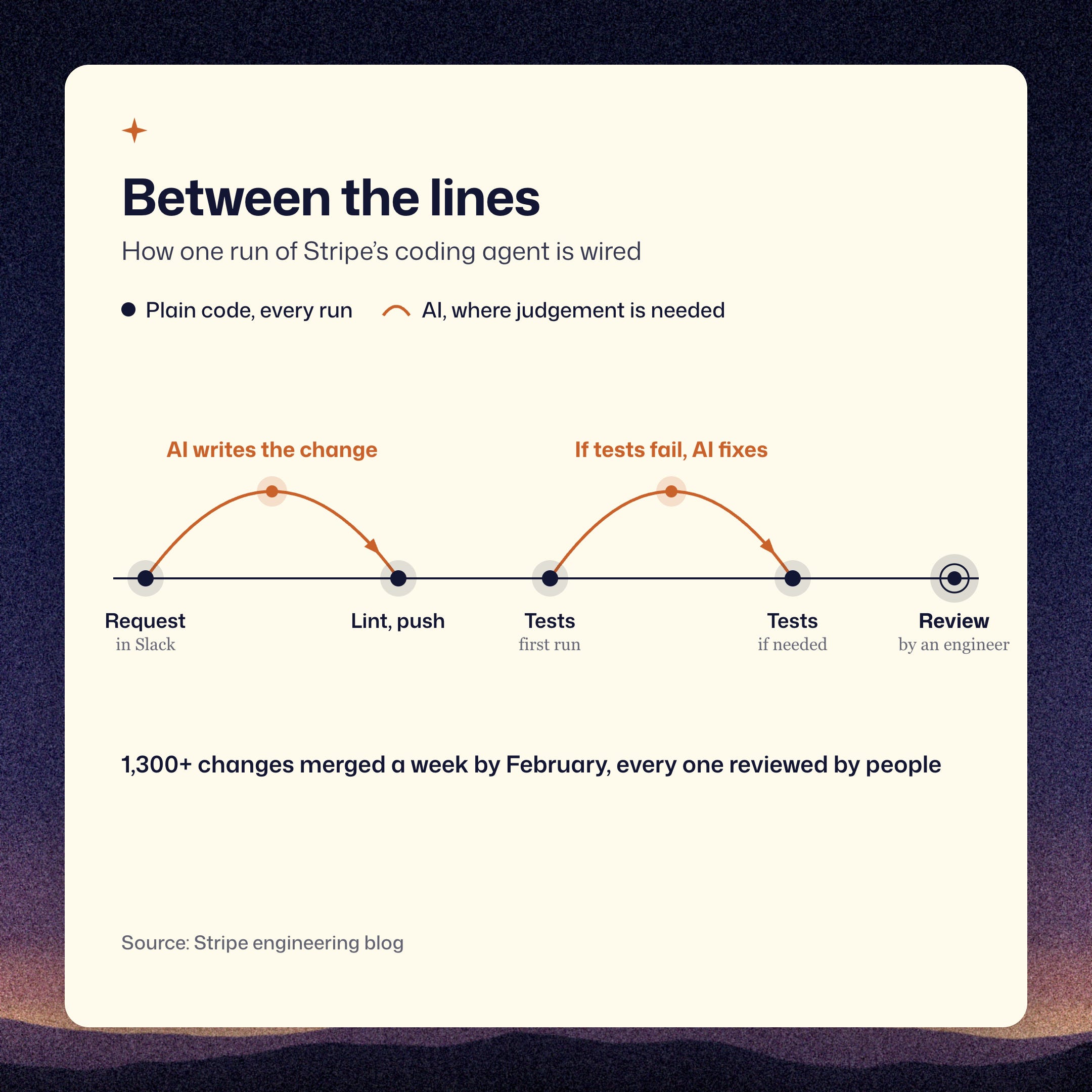
Each run typically starts with a request in the Slack thread and ends with testing; only after that is it ready for review, with no one needing to step in. I know some engineers who would recoil at the thought of this, but it is how they’ve managed to get 1,300 changes merged in a WEEK since February (roughly equivalent to the number of reports anyone non-technical would have to review).
Interestingly, it follows a specific recipe per run. The teams create the deterministic code (i.e., the non-AI code) first, as much as possible. This is the pre-checks, the tests, the guardrails. They then give the AI all the parts that need judgement, such as writing the change or fixing what fails. It gets two rounds of automated testing before being handed back to an engineer.
So what?
Work out what absolutely needs to happen deterministically in your workflow versus what needs to happen with an LLM. Remember that LLMs are probability machines, they exhibit intelligence but even 1% chance of failure when dealing with customer requests is too high. Use LLMs to create code that is guaranteed to work every time, wherever the path is clear.
4. Bet first on what you control
Outside of its own four walls, Stripe is going all in on AI. Its annual letter says it is serving all the top AI companies. It bought Metronome, which runs usage billing for the likes of OpenAI and Anthropic, and in August agreed to buy OpenRouter, a marketplace for AI models, at about $7.5 billion, according to the New York Times
Its biggest bet, as I read it, is on AI agents that buy things for us. Stripe co-developed the checkout protocol behind Instant Checkout in ChatGPT, which launched last September.
Unfortunately, six months later, OpenAI pulled it back, saying the first version didn’t offer the flexibility it wanted. Now, Walmart found that purchases made inside ChatGPT had about a third of the conversion rate when sending shoppers to its own site. I haven’t found the published figure for how much is bought this way, and Stripe’s own letter puts the industry at level 1 or 2 of 5.
Now, you could read many things into this. Firstly, Stripe is taking the risks it should in order to be a first mover. On the other hand, it’s interesting that conversion rates for an AI tool simply aren’t meeting current standards. It seems a bit unfair to compare a system that’s been optimised for more than a decade with a system that’s only just coming into place. On the other hand, there is a great lesson in Innovation: don’t build a SISP: Solution In Search of a Problem.
This is what often happens when we go technology-first in innovation, rather than focusing on what the customer really wants. Did ChatGPT checkout really solve a problem for customers? Obviously not enough of one.
So what?
There are many ways you could interpret this. The lesson for the builders and strategists reading this is: focus on the customer and the problem. Try to experiment through personal use and design first. ‘Dogfooding’, as Microsoft coined the term. Offer solutions to others once they have worked to solve a problem for you.
For Further Exploration:
Meet Stripe’s Knowledge AI Platform (Stripe)
How Stripe built Kai (LangChain)
Minions, part two (Stripe)
Harbor, Stripe’s AI prototyping tool (Stripe)
Stripe’s 2025 annual letter (Stripe)
All figures are Stripe's own unless otherwise marked, and I haven't found any independent verification of them.
See you in the next one,
James
Great title