



Hey , hope you’ve had a great week or getting into a good rhythm for the weekend.
Last week was Stripe. This week we’re looking at Ramp, a very interesting fintech, suggested by Benjamin Laval. For anyone interested in learning from a very experienced ex-Product Manager and now an AI adoption consultant, I’d recommend following!
TL;DR: Q&A style
Should AI be one team’s job, or everyone’s?
Build from a centre, but drive from the departments: Ramp's central team initially couldn’t keep up, so everyone built their own solutions. Now, a small central team builds the foundation, whilst every team builds on top of it.
How do you get people past the basics of AI Adoption?
Take the setup off people; lower friction by simplifying from many tools to one: The coding and technical stuff (e.g., terminal windows) kept most of Ramp’s staff stuck in a chat window. Ramp built its own AI app, Glass, that had a single sign-on and all the tool integrations they needed to work across the company.
How do you get people to change how they work?
Show people immediate results, not training: Ramp’s product chief says training doesn’t work. The people who got the most out of Glass had installed a ready-made skill on day one and saw results straight away.
Has Ramp’s AI strategy worked?
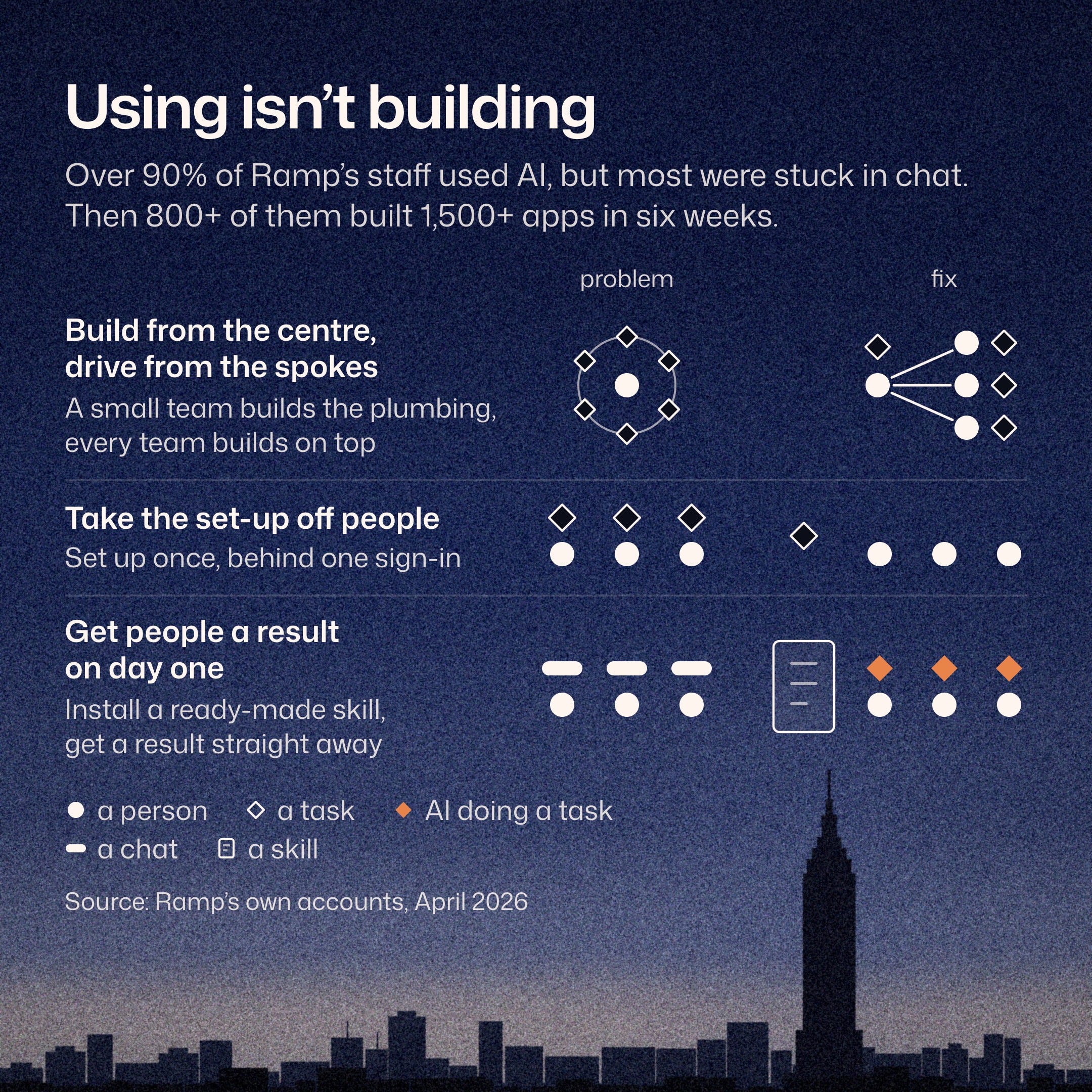
By its own account, yes. More than 800 people built over 1,500 apps in 6 weeks, but nobody outside has checked. Ramp pulled several levers at once, and we don’t know how useful most of the apps are.
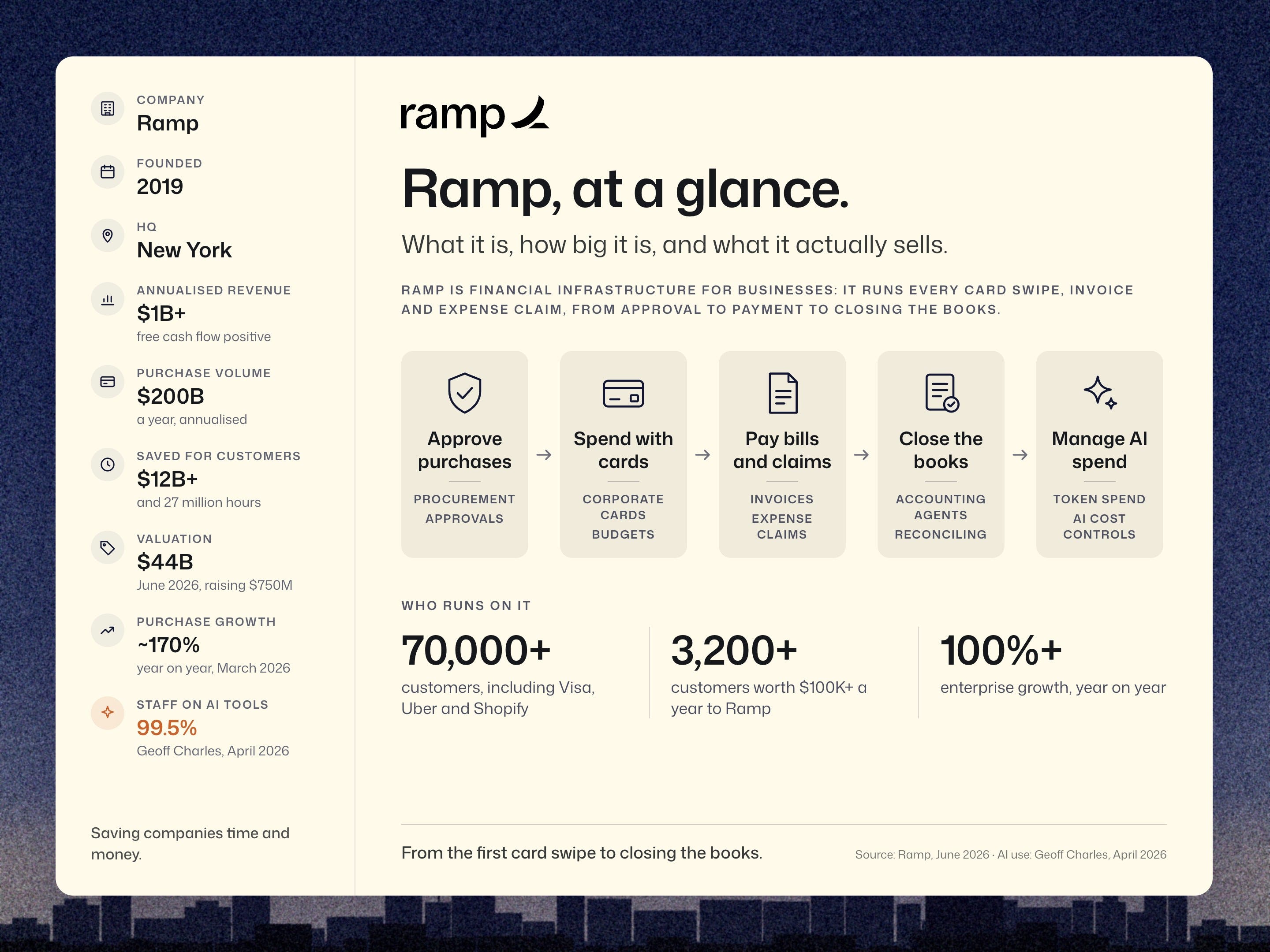
For those of you who are unfamiliar, Ramp is a corporate card and expense management fintech platform.
It was founded in March 2019, by Eric Glyman, Karim Atiyeh, and Gene Lee.

Eric and Karim had previously built Paribus, a Y Combinator-backed consumer app that scanned email receipts for price-drop refunds, which did very well and was eventually acquired by Capital One.
After leaving Capital One, Eric and Karim joined forces with Gene, and the trio saw a problem to take on: traditional corporate cards and expense management services profited from encouraging spending. They also had expense processes that were extremely outdated and cost business owners a huge amount of time just to complete.
So they combined corporate charge cards with an all-in-one platform, and made sure their business model was aligned with saving their customers money.
Within 18 months of launch, it had achieved unicorn status.
However, the problem with such parabolic growth is that their AI rollout couldn’t keep pace. In their words, in two stages for their operating model:
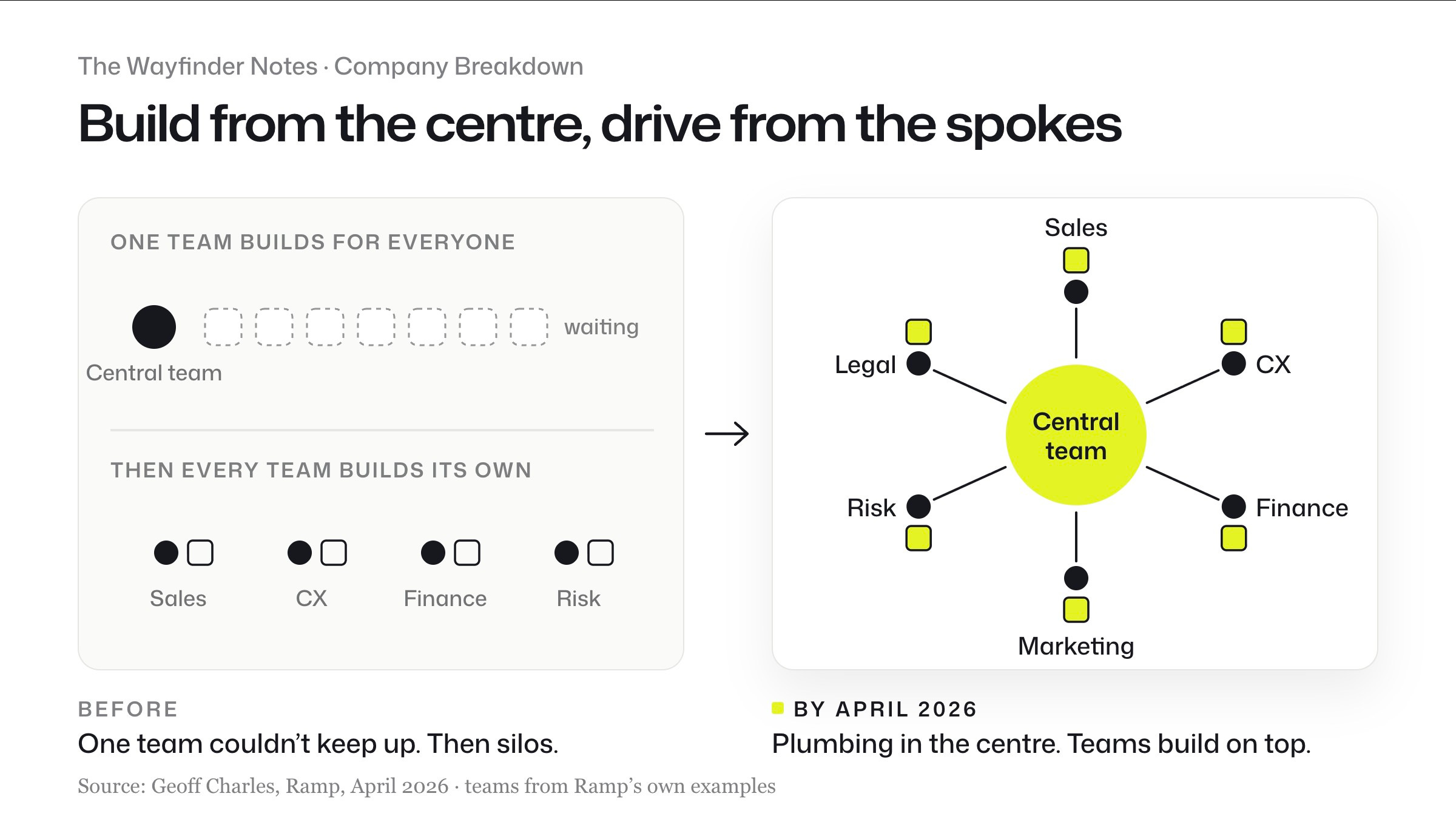
Overly Centralised Responsibility: One small central team was building AI tools for everyone, and demand was outstripping its capacity.
No Common AI Operating Layer: Every team was jerry-rigging its own tools, leading to silos, duplicated builds and activities, and “wildly different” setups.
In other words, Ramp was experiencing a common problem we’re seeing at many start-ups and small businesses now: everybody was using AI, but almost no team was coordinating enough to see real productivity gains.
Unlike many large businesses, where pure adoption and usage are often the key constraints, this was about setup and the operating model: how the pieces on the board are arranged and communicate.
Yes! (Admittedly by its own account) By April, more than 800 people had built over 1,500 apps in 6 weeks. Crazy! People who aren’t engineers were proposing 12% of the human-started changes to Ramp’s product code.
So how did they overcome this?
1. Build from the centre, drive from the spokes
This veers into consulting jargon, but it’s also how Ramp thought about it.
Ramp’s initial struggle was that it had given a central team sole responsibility for internal AI, understanding internal needs, etc.
This is common; many companies still do this. The reasoning is that AI is a risk and a distraction: something to experiment with, not necessarily something you want to devote resources to, as it may distract from driving the business forward.
However, the team couldn’t keep up with the extreme growth. Meanwhile, the rest of the teams were using AI anyway and developing their own ways of working.
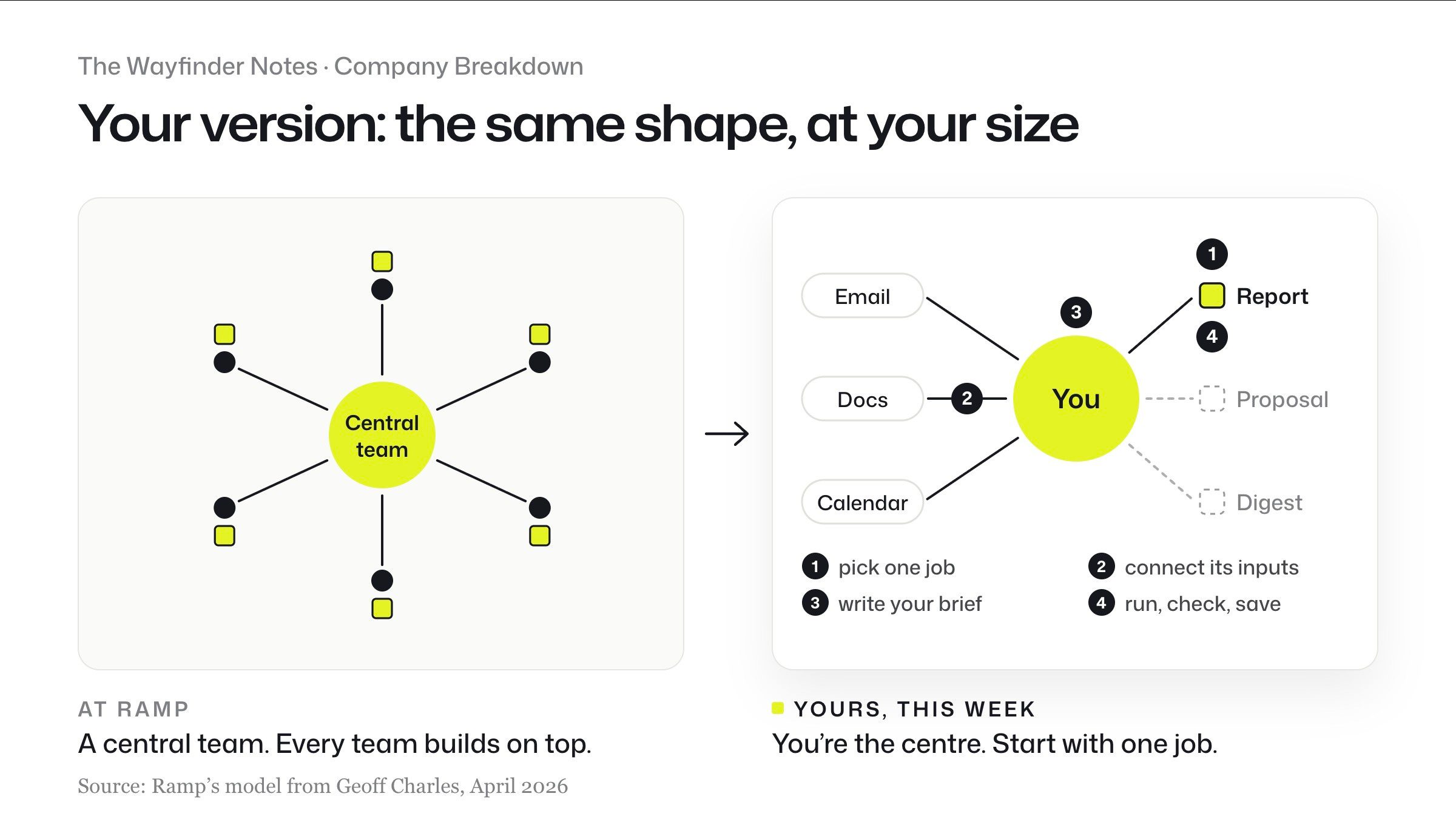
The solution was to have a small central team build the connection-coordinating layer: the platforms, the connections, the data, and the training. Every other team then built on top of that foundation. The feedback sets the central team’s roadmap, and each team can personalise it to their needs. Geoff Charles, Chief Product Officer for Ramp, called this “build from the centre, drive from the spokes.”
So what?
Many businesses are familiar with the concepts of “shared services” and hub-and-spoke models, but not enough companies are applying this to AI. Solopreneurs should similarly coordinate agent context: one central hub of rules or data, with other folders connecting to it but serving more specialised purposes.
2. Take the set-up off people
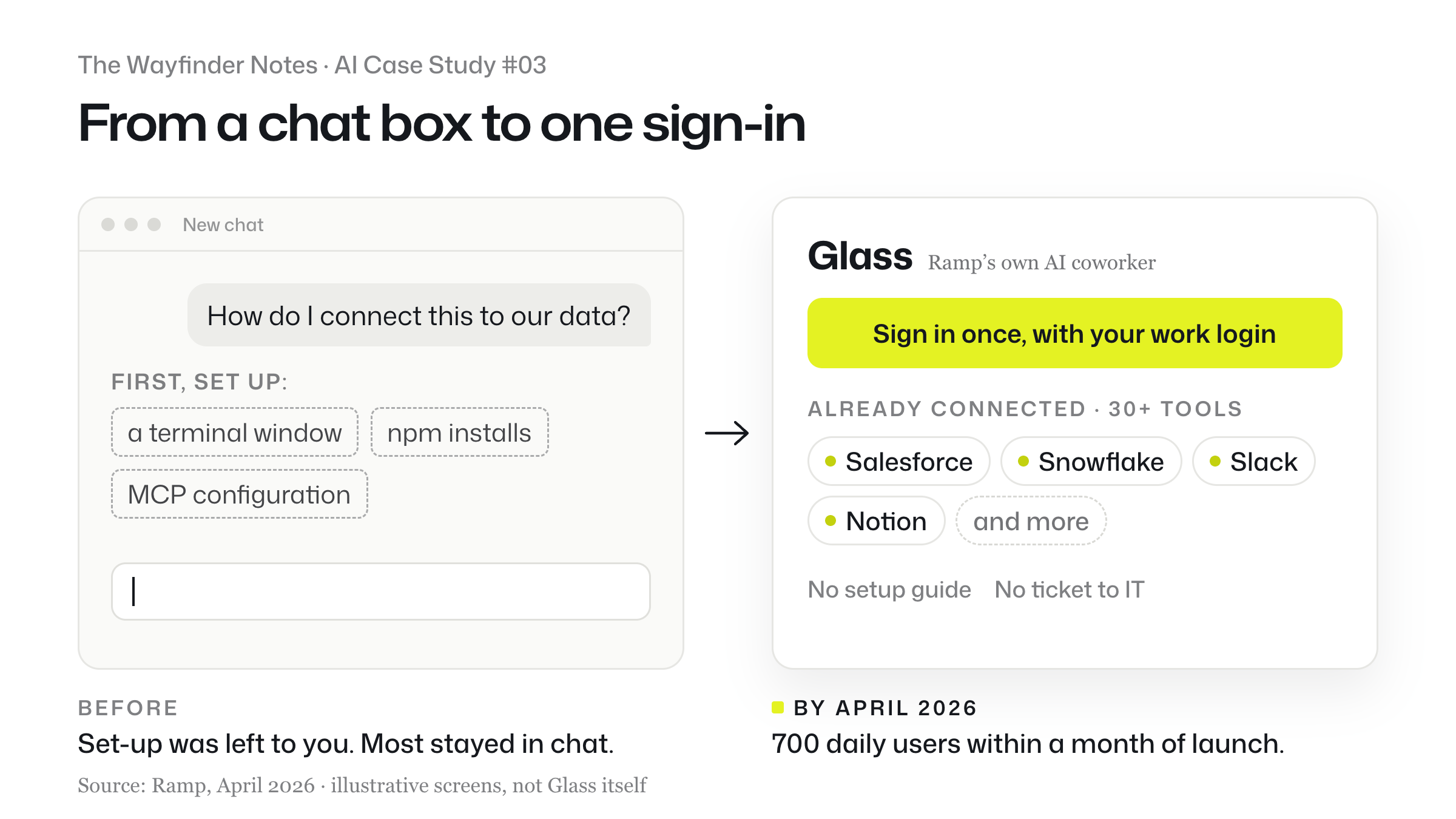
The second big issue is a bit more basic. Over 90% of Ramp staff were using AI, but they were still stuck in the chat window. Charles put it down to the setup. The models weren’t good enough, he says, but terminals, installs, and all those connecting tools were too hard for most people. Meanwhile, those who did push through the pain barrier had “wildly different setups,” and there was no common platform so what one person learned helped nobody else.
In three months, a small team built Glass, Ramp’s own version of Anthropic’s co-work. The idea was that you sign in once, and all the tools necessary to do the work internally, including Salesforce, Slack, Notion, Figma, and Playwright, would be connected. There would be no setup guide and no ticket for IT. As Charles put it, “If the user has to debug, we’ve already lost.”
They built it as a universal platform, the same for engineers and product managers alike, with memory, so each session could already understand colleagues and projects, and so one person’s breakthrough could be easily shared.
So what?
I think a lot of the “this isn’t for me” answers we hear are really about not being thoughtful enough with design and infrastructure. Ramp’s staff were already using AI. They just needed a less overwhelming approach. It’s the same move Stripe made with Kai.
3. Show people immediate results, not training
But how do you just… get people started? Well, Glyman has been very candid about what they got wrong at first: like plenty of bosses, they told people to go and try AI, but at work, it’s so awkward to admit you don’t know what you’re doing. Charles was blunt about training. He says it doesn’t work, though office hours and workshops help. Two things did help:
Management showed it was okay to experiment and fumble: Glyman showed his first coding session with a coding tool, fumbling as he tried to get it working.
They made sure that people using Glass installed a skill on the first day, so they felt some value immediately from it.
For those unfamiliar, a skill is a packaged recipe for one job, like a how-to guide. Now Ramp has built a marketplace for them called Dojo, and since then, over 350 have started sharing them with each other. In Ramp’s example, given online, a sales rep works out how to analyse recorded sales calls and draft battle cards, packages it, and every rep gets it.
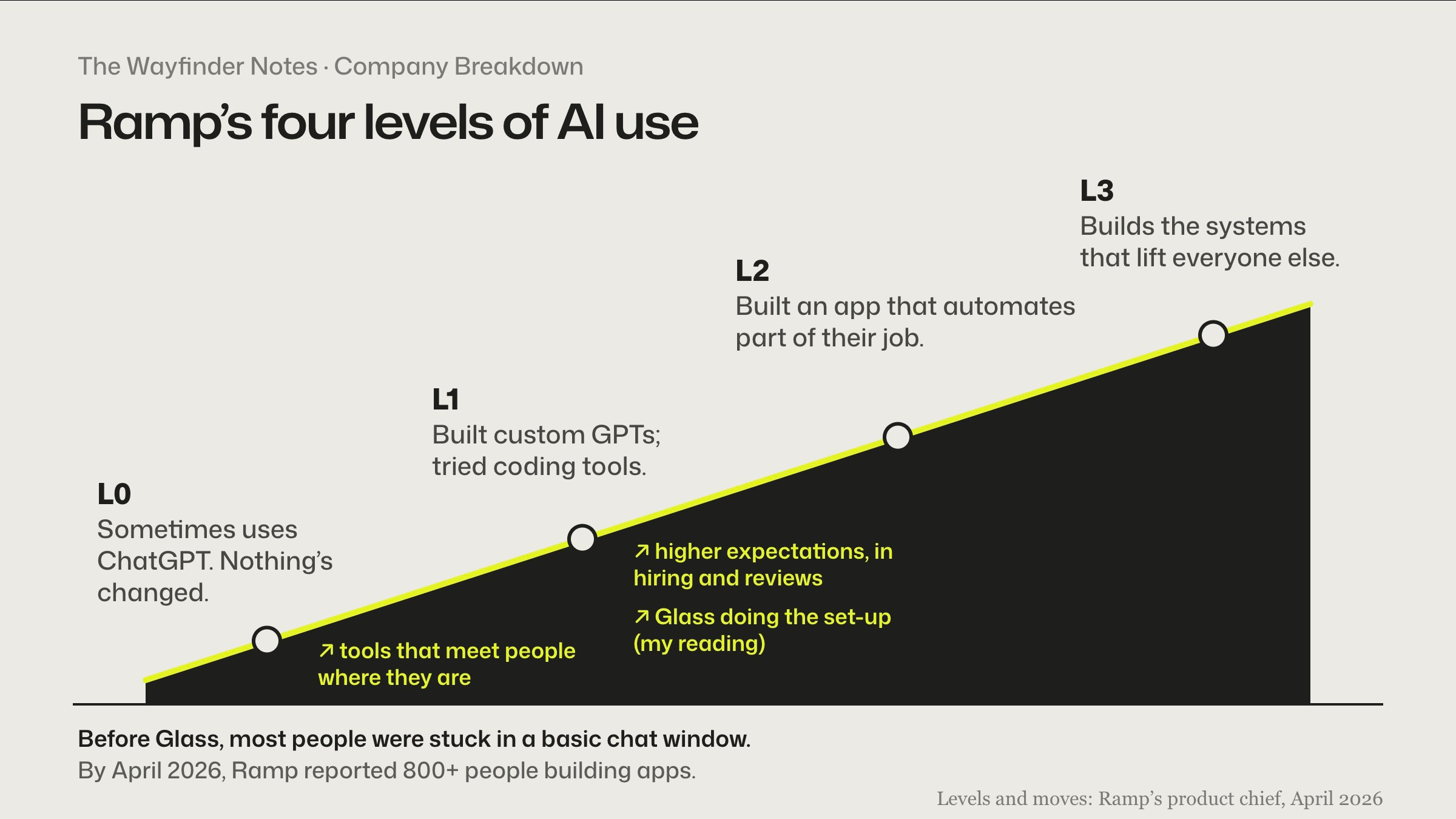
Ramp is really pushing this as well. Now, it sorts people into four levels, from L0 (uses ChatGPT occasionally, no change) to L3 (builds the system that lifts everyone else). even runs usage leaderboards for every team and person, and every new hire must be good with AI.
(Although, as we’ll see in the coming weeks, leaderboards can lead to some unintended consequences)
So what?
Ramp’s people credit different levers. In Charles’s telling, higher expectations moved people from dabbling to building. The Glass team says the push was already there. “We’d created urgency without providing enough infrastructure.”
Personally, I would agree with the Glass team. A push only works once there’s something to actually get people onto. Ramp pulled several levers at once, including a hackathon for 700 staff, so one account can’t prove which one did the work. You can’t go wrong by looking at the setup and the first result, then the push afterwards.
Concluding Thoughts
Connecting these three moves was one thing Ramp did really well. The management team weren’t distracted by training, the model types, new tools, or metrics: they knew what mattered was coordination.
We can take this and apply it to businesses now, no matter the size. If it’s just you, you’re the central team, so the setup is yours to do once. If you have a team, you can have one person at the centre, and everyone builds on top. A shared file folder system is enough for a very small team.
Personally, I use simple applications, as I mentioned previously:
Strategy folder in the centre: a very simple app to track our goals, plans, etc. Departments: very simple apps connected to it. Training agents to treat these only as a brief summary and tracking folders.
Top tip: keep it brief. Otherwise, agents will overfill with technical debt and verbosity.
I’ll put together a guide on how to set this up securely soon.
One question before you go
If you’ve tried to build with AI and stalled, what were your biggest pain points? At the setup or picking what to build? Feel free to email your reply or comment!
Would be great to know for the AI Guides series.
For Further Exploration
How to get your company AI pilled (Geoff Charles, Ramp, April 2026)
We built every employee at Ramp their own AI coworker (Ramp’s Glass team, April 2026)
Eric Glyman at HumanX, with the Wall Street Journal’s Kate Clark (April 2026)
Why we built our own background agent (Ramp Builders, January 2026)
Ramp raises Series F at $44 billion valuation (Ramp, June 2026)
Cheers and see you in the next one,
James
James, I’d push back a little on “training doesn’t work.” A ready-made skill, a real task and support when someone gets stuck give people a way to learn as they work. The workshops and office hours seem part of that too. I’d love to see how many of those skills are still being used and improved a month later. That would tell us more about lasting value than the app count.
Fifteen hundred apps in six weeks is impressive until you ask how many are still used. You say yourself nobody outside checked. I'd rather see the count after three months than the count at week six.