


Hey, welcome back!
In this edition, we’re going to look at Duolingo. They spent 12 years building their first 100 language courses, and since April 2025, thanks to AI, they’ve announced another 148. That’s a fair impact.
The thing is, once you can produce that much more, what do you do with it?
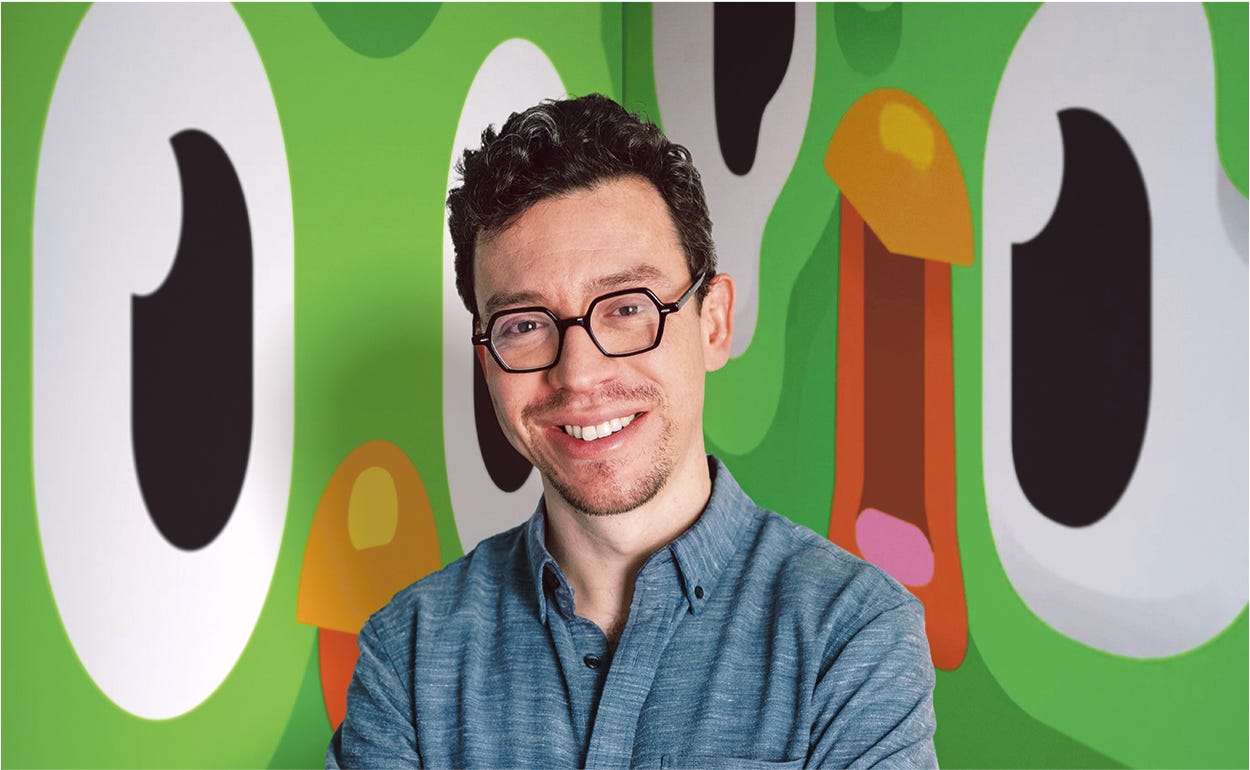
The story of Duolingo is fascinating, especially since its founder, Luis von Ahn, was one of the co-inventors of CAPTCHA tests. So much like Tobi Lütke of Shopify, he fits the early-adopter mold.
Now, Duolingo is even more interesting because it has taken great steps and very well-publicised not-so-great steps into the foray of AI strategy and implementation. Let’s dig into them!
TL;DR: Q&A
How do you encourage useful AI work without rewarding busywork?
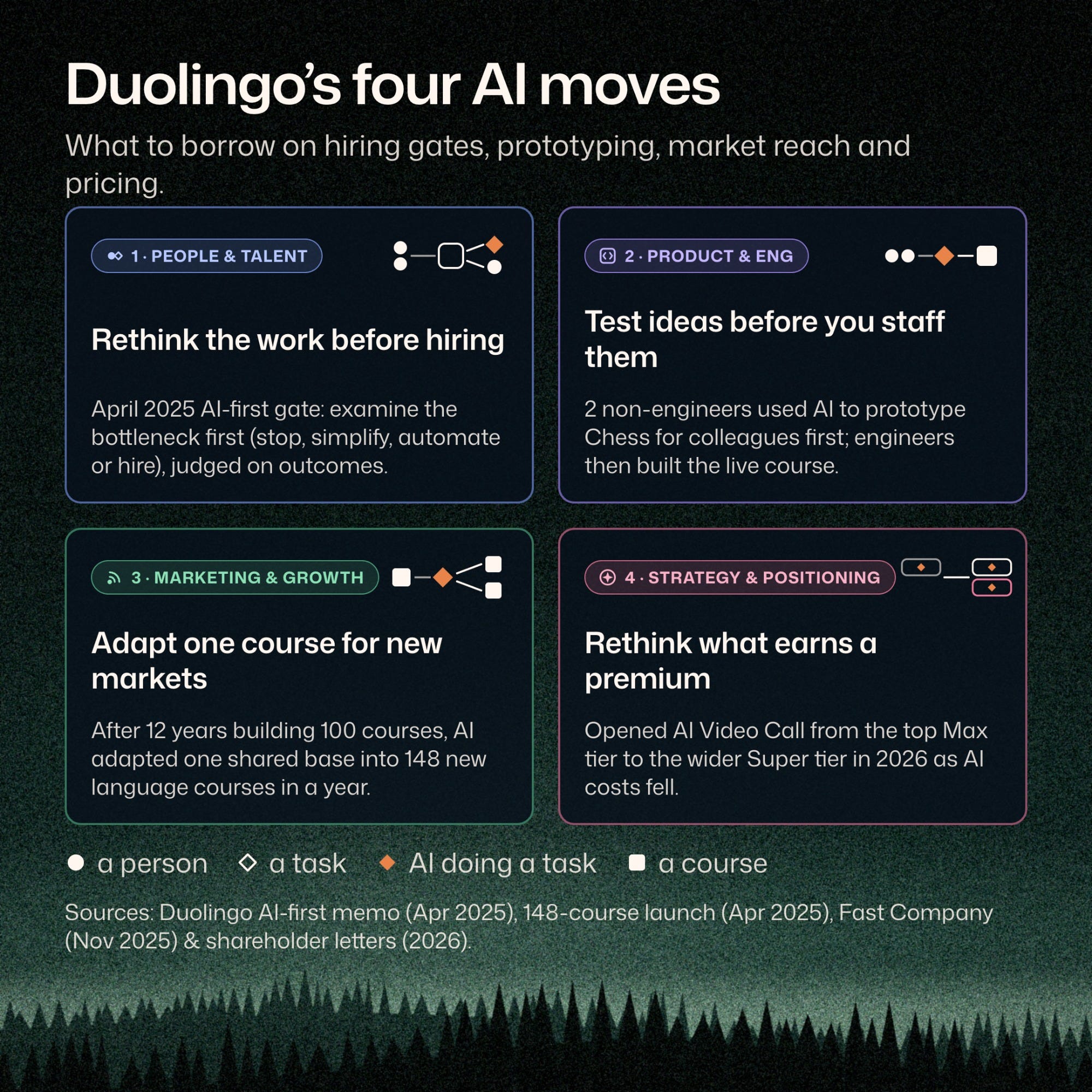
Enforce a principle of exploring AI use, but with a strong culture of feedback to reverse quickly when it goes too far. Much like Shopify, Duolingo enforced a principle that required teams to consider But, by that same token, when they overstepped, such as when using AI for performance reviews, they quickly pulled back.
How to take full advantage of AI’s speed and productivity?
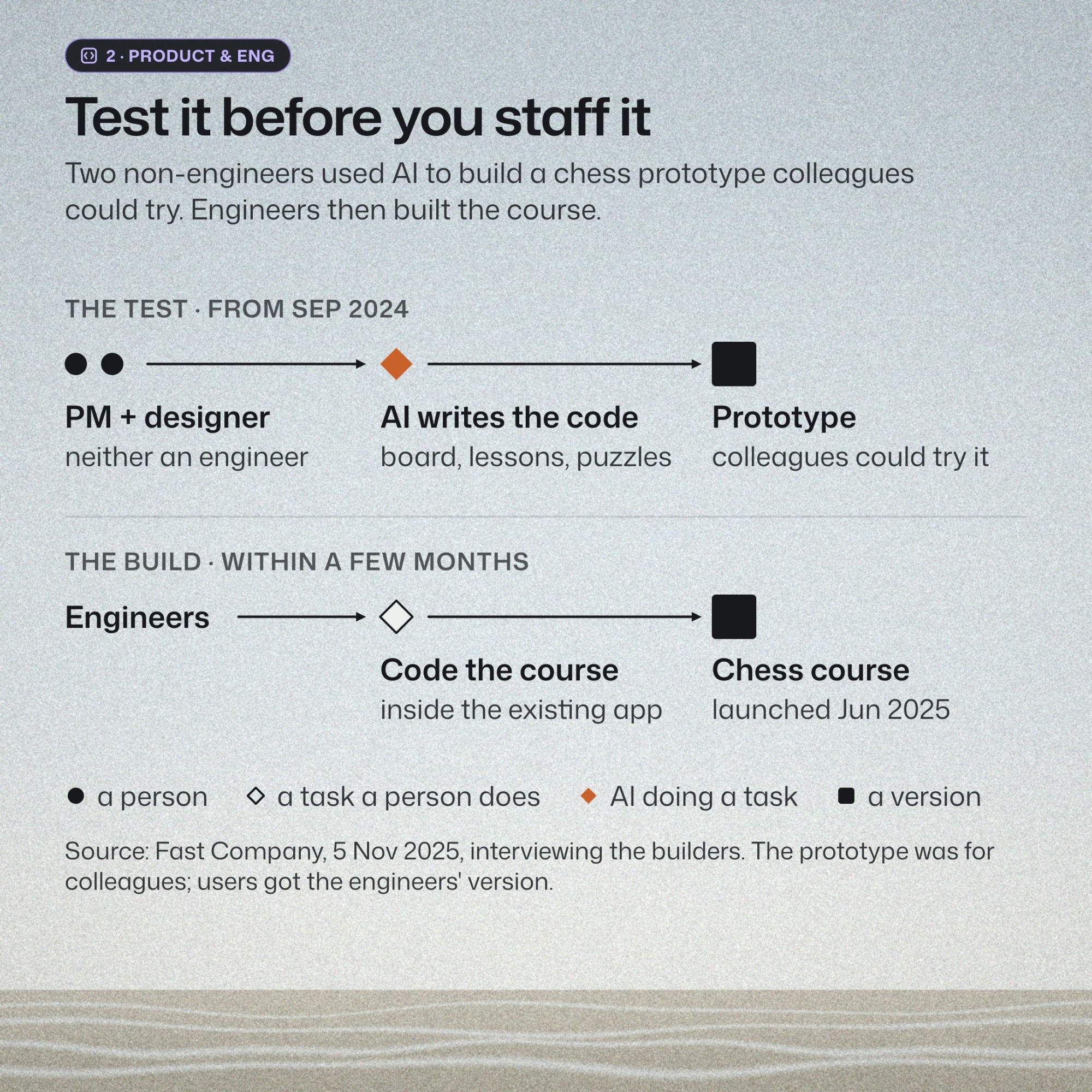
Start experimenting. Go as fast as you can, giving yourself or a small team enough licence to experiment greenfield. Test the ideas you thought needed a bigger team. For Duolingo, a product manager and a designer used AI to prototype Duolingo’s Chess course in only a few months. Engineers then helped turn it into a product.
What are the best quick win opportunities with AI?
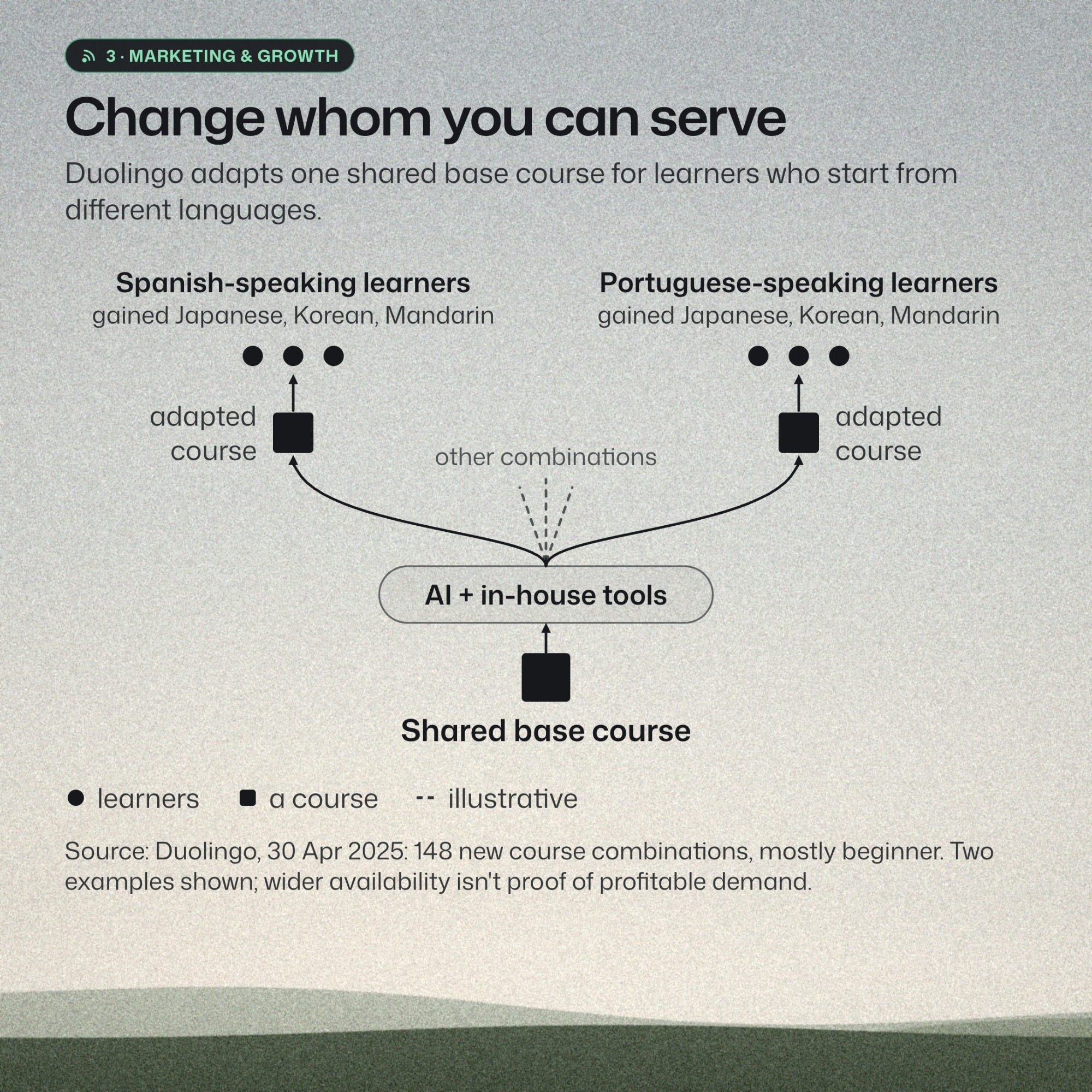
Look at where you have an existing structure that LLMs can work within and copy over to reach new customers your existing offer leaves out. Duolingo reused a shared course structure to offer more language combinations, a quick win that leveraged the existing structure and AI for rapid development. A smaller business might change its customer, service or frequency, as long as the methodology exists and is proven to work.
How should AI change what you charge for?
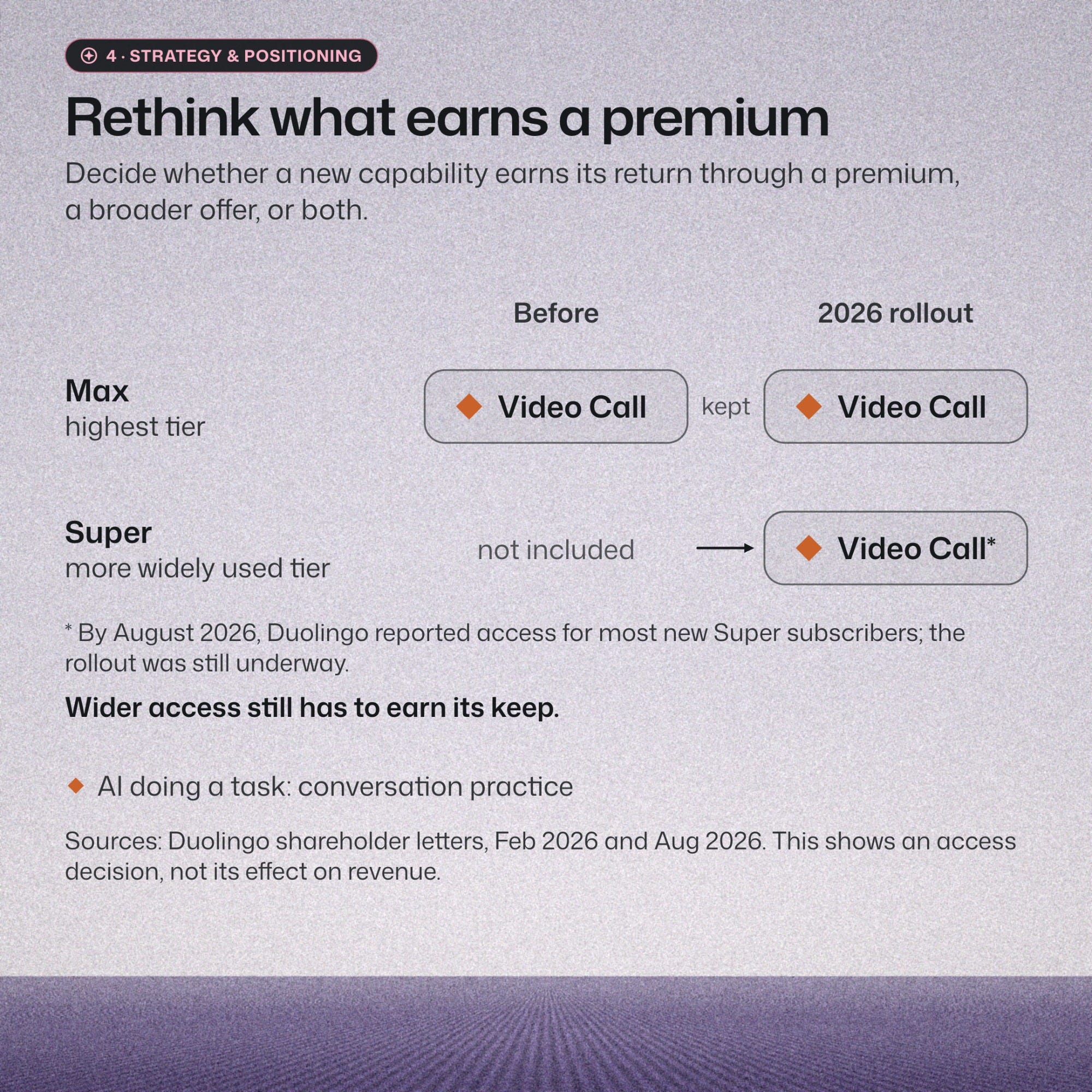
Charge for AI access as a premium offering if you can but don’t let it interrupt your core offer and advantage. Duolingo began moving Video Call, its AI conversation feature, beyond its highest subscription tier. Faced with the threat of AI voice offerings and lessons, it realises user growth, gamification and community are more important than short-term earnings.
Has Duolingo’s AI strategy worked?
For expanding production, by itself, yes. It reported 148 additional courses developed in under a year. That doesn’t establish better learning improved or how much AI contributed to commercial results. Several things changed together. So the overall outcome has been positive so far despite negative media coverage.
1. Don’t reward AI use that doesn’t help
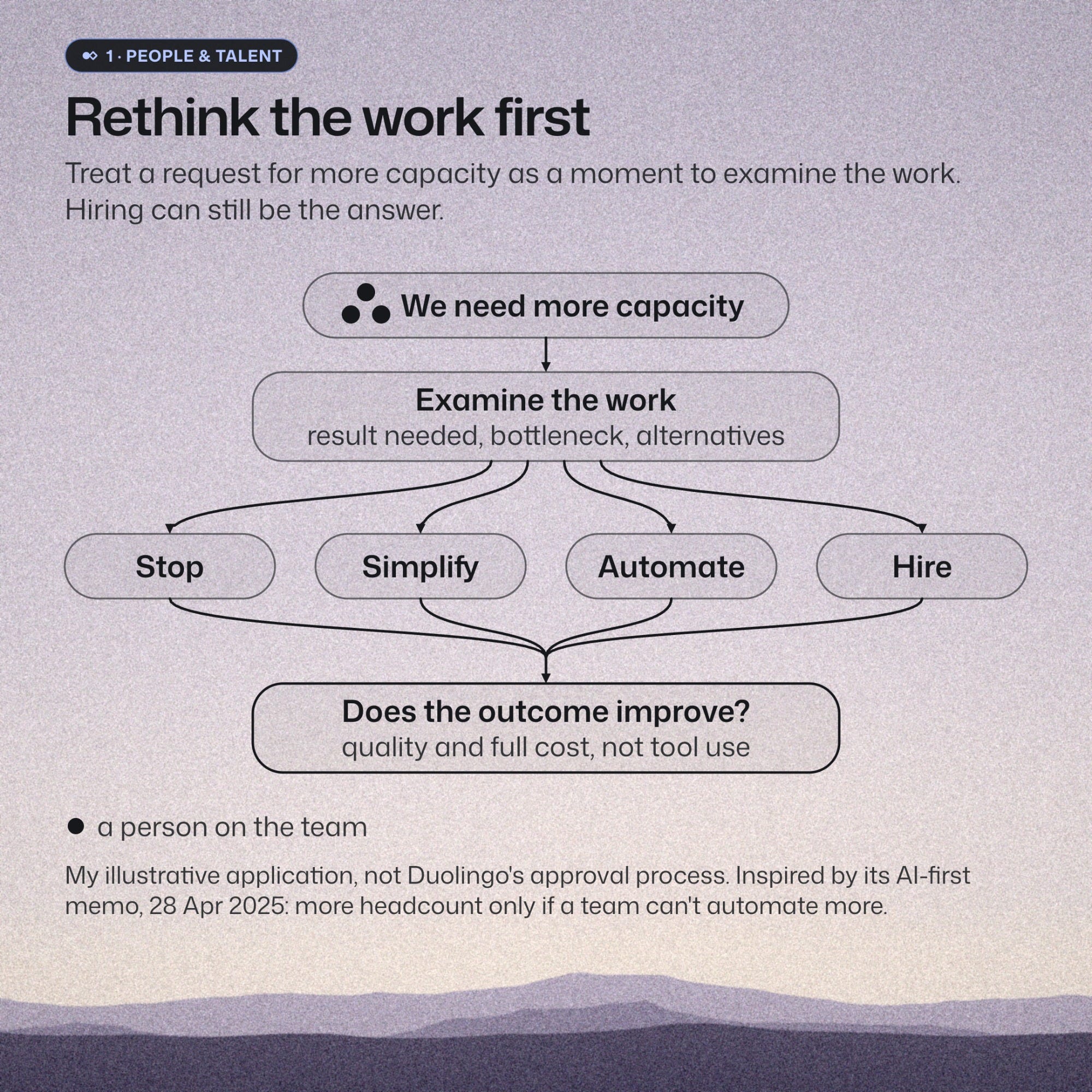
Duolingo put the question into a decision managers already make: can this team hire?
Its April 2025 AI-first memo said that teams would receive additional headcount only if they couldn’t automate more of their work.
If you read the Shopify breakdown, this is familiar territory - where teams apply the principle of being resourcefully frugal. It gives them a reason to investigate, rather than leaving experimentation as something everyone will get around to.
Where Duolingo got it wrong, however, was in a separate rule in the same memo: including AI use in performance reviews. In a May 2026 interview with Bob Safian, chief executive Luis von Ahn said staff told him it encouraged uses that didn’t improve their work. Soon after, that requirement went.
Duolingo had already stated a sensible principle:
“we use AI to serve our learners and advance our mission”
Duolingo’s Golden Rule, presented by Natalie Glance, Chief Engineering Officer, at LeadingEng New York 2025, slide 10.
It’s important to encourage creative use of AI, but Duolingo’s issues show that when AI is overused or overstipulated (i.e., when it’s not used to solve an explicit problem faced by the person or team), it can go wrong. It’s important that AI is encouraged to solve a real problem, not just to be used for experimentation or ‘tokenmaxxing.’ AI in the right places at the right time is important, even if it makes for a less impressive AI update.
So what?
Building on our previous learnings, experiment, but don’t force AI use where it doesn't solve an explicit problem in your workflows or routine. Much like we’ve seen, it's ineffective to enforce training for training's sake.
2. Test the ideas you thought needed a bigger team
An experiment should give you something useful to judge. Duolingo’s Chess course is a good example.
Luis von Ahn says he initially rejected chess because he saw it as a game, outside Duolingo’s educational purpose. He changed his mind and gave the project the go-ahead.
The first prototype came from product manager Edwin Bodge and product designer Tyler Murphy. Even more astonishingly, neither of them was an engineer. They used Cursor, an AI coding tool, to build a version of the board, lessons and puzzles that colleagues could try while the curriculum was still taking shape.
They managed to get to a full-fledged MVP course to test with consumers in only a few months. Unbridled by previous processes they were given free rein to try new things. The full-fledged product was then developed by engineers after, but the two product specialists got it to a place that was good enough to test demand.
So what? Look at a product idea you’ve put aside because you thought you lacked the team or skills. What would you need to make for a potential customer to try it? Give that a small budget and a time limit. If you’re managing a team, give a few resources free rein to see how far and fast they can go.
3. Reach people your existing offer leaves out
Duolingo’s shared-content approach starts with a base course and adapts it for learners from different language backgrounds. Its 2025 launch made seven popular non-English languages available across all 28 supported interface languages, with help from AI and internal tools. For example, Spanish and Portuguese speakers gained courses in Japanese, Korean and Mandarin.
This is a useful result to give Duolingo credit for: those learners gained access through a language they already understood. The larger course count meant something they could use. This was previously quite costly, but is now cheaper with LLMs.
This works, though, because it is a strategy that plays to LLM strengths. Duolingo had an existing structure and methodology in its courses; LLMs could just speed up creation within that structure, thereby opening up new adjacent markets.
Imagine a smaller consultancy with a defined structure for its client offerings. LLMs enable the creation of reusable methods or ‘skills’ that make smaller clients worth serving. Or an annual review could become a more frequent service. Both depend on customers wanting the change.
An agency that previously charged $3k per month to 10 clients can now better scale its methodology by leveraging skills and LLMs, offering it as a $1k system to 50 clients.
It’s the possibility we explored in Age of the Artisan: as delivery gets easier, the markets worth serving can change.
So what?
Look again at the customer, the frequency, and the scope of your offer. What couldn’t you afford to deliver before? Where have you created an existing profitable offering that can be encoded for LLMs?
4. Add an AI offering if you can, but don’t let it distract from your core offering
Then there’s what you charge for. Does the improvement deserve a premium, or would it do more for the business as part of the offer customers already buy?
In February 2026, Duolingo announced plans to move Video Call from Max, its highest subscription tier, into the more widely used Super tier, alongside more free AI speaking practice. A feature that had helped distinguish its most expensive subscription would reach more people.
By August, it reported that most new Super subscribers had Video Call. Duolingo attributed changes in user growth to several product and marketing interventions, so we can’t isolate the effect of broader AI access.
This brings us back to Shopify’s question: what would customers still need you for if your market starts to change because of the AI labs. For Duolingo, it’s the whole learning experience via the gamification angle: curriculum, feedback, useful practice and motivation to return. Faced with the threat from AI voice, their brand loyalty and doubling down on gamification become their stronger advantage.
So what?
A valuable new AI offering might justify charging more, but do not let it overshadow your core offering. AI is changing the strategic landscape of language learning, but Duolingo offer us the lesson that it's important to stay focused on why customers return to your product.
Go experiment
If there’s a product idea you’ve ruled out because you didn’t think you could do it, just try - like I’ve written about before, often the only things holding us back are limiting beliefs.
Just remember, you need someone who understands the customer’s problem and can judge whether AI would be useful in solving it or in creating a solution.
What problems are you facing recently? Start there, then just prompt until you get somewhere interesting.
For Further Exploration
Duolingo’s AI-first memo (Luis von Ahn, April 2025)
Duolingo’s CEO admits where he got AI wrong (Robert Safian, Fast Company, May 2026)
How Duolingo vibe coded its way to a hit chess game (Saleah Blancaflor, Fast Company, November 2025)
Duolingo launches 148 new language courses (Duolingo, April 2025)
Lessons learned using generative AI for product development (Natalie Glance, LeadingEng New York, 2025)
Q4 and full-year 2025 shareholder letter (Duolingo, February 2026)
Q2 2026 shareholder letter (Duolingo, August 2026)
Related Wayfinder breakdowns: Shopify’s AI strategy, Stripe’s AI strategy, how Ramp got 800 people building with AI, and what Klarna got wrong about AI customer service. Browse all Company Breakdowns.
Cheers and see you in the next one,
J
James, I think there's a bigger strategic lesson here about where value moves as AI makes production cheaper. Duolingo can now create courses at a fraction of the previous effort, but producing more content doesn't necessarily mean people learn more effectively. Its real advantage may increasingly lie in what happens after the content is delivered: engagement, feedback, motivation, and measurable learning outcomes. That's a shift many enterprises will face. As AI makes producing products and services easier, competitive advantage may move toward the ability to deliver better outcomes and continuously improve them.
Interesting analysis, James! What we're wondering is whether Duolingo could spend heavily developing sophisticated AI learning features, only to find that those same capabilities are becoming standard in general-purpose AI platforms like ChatGPT and Claude. If someone can already get personalized language instruction at no additional cost through an AI assistant they're paying for, and use that same assistant for countless other things, what happens to Duolingo's value proposition?
We'd wager that someone could already build their own personalized version of Duolingo inside Claude, complete with structured lessons, exercises, progress tracking and instruction tailored to their individual learning curve. Duolingo could become significantly better at what it does while becoming less necessary to its customers. And we're saying this as active, daily Duolingo users ourselves!